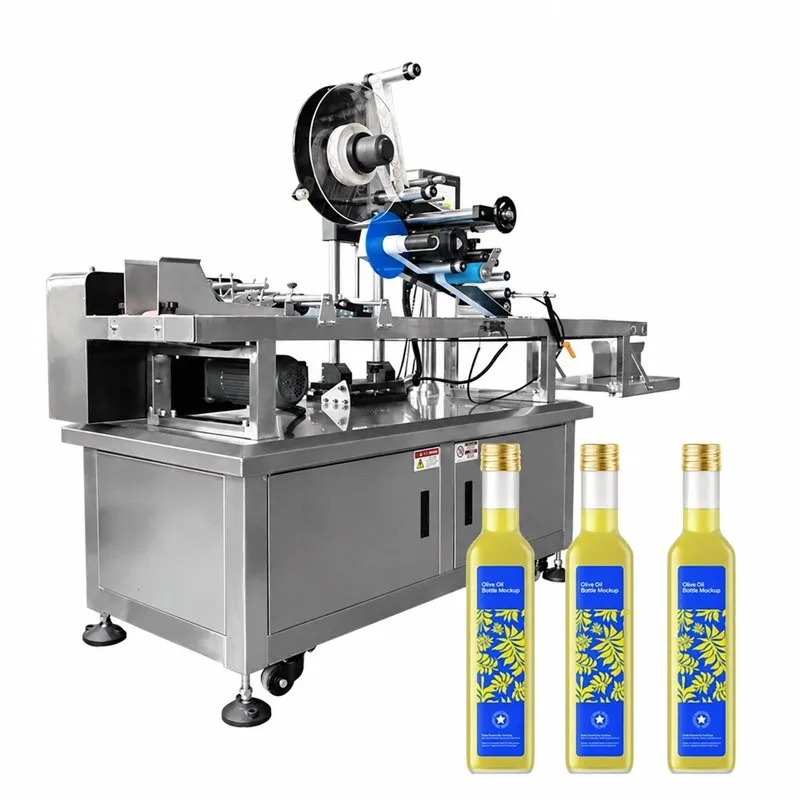
Edible oil bottling line
Labeling stage (flat surface)
Our line page lists liquid filling, capping and multi-side labeling for oil bottles.

[Applications]
Start from the oil and the bottle format; filling, capping and labeling follow.
[01]
Oil is thin next to honey or sauce, so feeding is easy and the work moves to controlling drip, foam and bottle cleanliness.
| Give us | Why it matters |
|---|---|
| Which oil, and its thickness at room and filling temperature | Oil thickens when cold. A cool storeroom changes fill time and drip behavior. |
| Bottle material: PET or glass | Light PET bottles need stable handling; glass is heavier and more fragile. |
| Bottle shape: round, square or rectangular, with height and neck | Square bottles need labeling on more than one side and different guides. |
| Closure: screw cap, tamper-evident cap, pour spout or inner seal | Spouts and inner seals add stations and parts. |
| Fill volume and number of sizes | Each size changes nozzle, guides and label parts. |
| Label panels: front, back, side or wrap | Sets the labeling setup. |
[02]
Oil flows easily, so the filler on a liquid filling line is simple in principle and drip is the main problem. Oil left on the nozzle after shut-off runs down the neck and onto the bottle, and a clean neck matters for the cap and label. Nozzle shut-off, drip trays and bottle spacing are set to keep oil off.
Air carried in with the oil can foam in the bottle, and a fast fill can splash. Filling from the bottom up, or slowing near the end, are the usual ways to limit this. We pick the method for your oil and bottle.
Bulk oil usually arrives in a tank or drums. We agree in advance how it reaches the filler and how it's kept at working temperature. Drums, pails and non-edible oils are assessed separately.
[03]
Capping depends on the closure. Screw caps are common on oil bottles; a pour spout or inner seal adds a station. Tell us the exact closure, and send a drawing if you have one.
Square bottles often carry labels on several sides. Our catalog lists a flat-surface labeler for square PET and glass oil bottles, and our edible oil line page names multi-side labeling as a stage. Either each side gets a labeling head or the bottle passes through more than once; the proposal says which.
Oil on the bottle weakens label adhesion. Our labeler page lists multi-stage pressure rollers against label peeling from oil residue. A clean bottle after filling matters as much as the rollers.
[04]
Two of our product pages relate to oil bottles.
Labeling stage (flat surface)
Our line page lists liquid filling, capping and multi-side labeling for oil bottles.
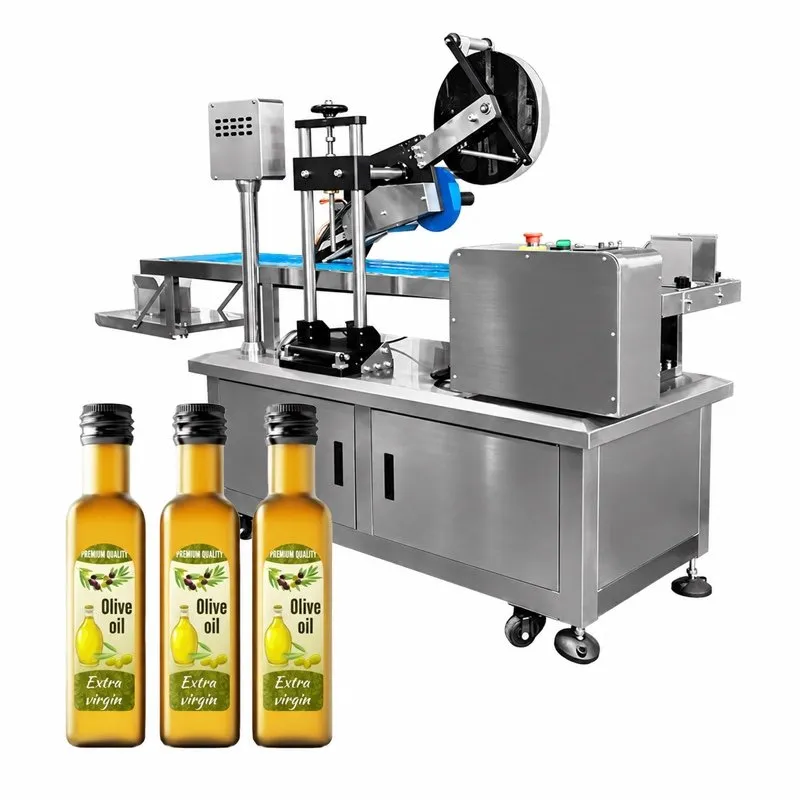
Labeling machine (flat surface)
A flat-surface labeler for square PET and glass oil bottles, with a multi-stage pressure-roller system.
[05]
We publish no speeds or floor areas here. They depend on the oil, the bottle and the stations.
[06]
Oil leaves a film on everything. Drip trays, nozzles and conveyors need regular cleaning, and a slippery floor is a safety problem around the line. Plan drains and a cleaning routine.
Changing oil means flushing the product path. Changing bottle size means new guides, nozzle and label parts, and going from square to round can change the whole labeling approach. List every bottle you expect to run so the changeover is planned into the first line.
[07]
Oil lines are configured and built to order around your oil and bottle. The table is the usual starting scope. On site, commissioning runs empty first, then with your oil.
Oil filling into bottles
Filler and nozzle configured for your oil and bottle.
Capping and multi-side labeling
As configured for the bottle shape.
Bottle feeding or unscrambling
Coding and inspection
Drums, pails and other oils or containers not described here
Oil refining, blending and bulk storage
Power, compressed air, drains and floor
[Request]
Send the oil type, the bottle material and shape (photos showing the neck finish help), the closure, and how many bottles a shift you need.