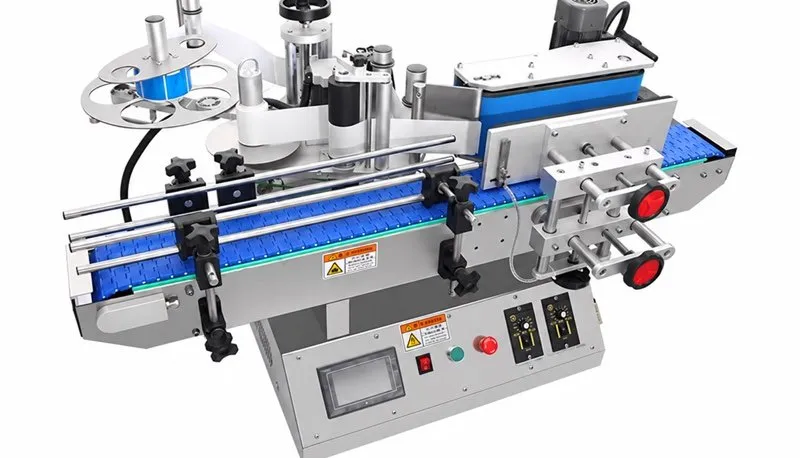
Shampoo and flat bottle labeling machine
Labeling machine (tabletop)
A labeler listed for flat bottles and oval shampoo containers, with a pressure-roller system for large labels.

[Applications]
Foaming, bottle shape and cap or pump style decide the line. Tell us all three.
[01]
Shampoo foams, and most of the line follows from that and from the closure.
| Give us | Why it matters |
|---|---|
| Thickness at filling temperature | Thicker shampoo fills slower and holds more air. |
| Surfactant level and foaming when poured | Heavy foamers need slower or bottom-up filling. |
| Bottle material, shape (round, flat or oval) and neck opening | Neck size limits nozzle size; flat bottles need different guides. |
| Closure: screw cap, flip-top, disc-top or pump | Decides capping station and cap feeding. |
| Fill volume and number of sizes | Every station needs a planned format change. |
| Label size and placement | Large labels on flat surfaces can wrinkle. |
[02]
Foam is the main issue. Foam in the neck gives short fills and a messy bottle. Filling from the bottom of the bottle upward, slowing the fill near the end and shaping the nozzle are the usual ways to limit it. Which suits your shampoo depends on the product and the bottle.
Air in the product line turns into foam too. A feed tank at a steady level, a line without sharp bends and a filler that doesn't whip the product all help. The liquid filling lines page covers filler choice in general.
Fragrance and color changes mean cleaning the product path. If you change formulas often, say so, and we'll choose the filler with cleaning in mind.
[03]
A screw cap is the simplest closure to place. Flip-top and disc-top caps must be oriented first, so cap feeding becomes part of the line design.
A pump dispenser with a dip tube is harder. The tube has to enter the bottle without bending, and the pump head has to be tightened to a set torque. We look at these closures case by case.
Cap color and style change often across shampoo ranges. List the closures you expect to run so the capping head and feeder cover them.
[04]
Shampoo bottles are often flat or oval with large labels, which can wrinkle or trap air. Our shampoo, lotion and flat bottle labeler page describes a multi-stage pressure-roller system meant to keep large labels smooth, and our lotion and cosmetic labeler page lists a similar approach.
A change in bottle shape changes the guides, the holding parts and the label position. Planning several bottles from the start keeps changeover short.
Coding and inspection are options: a code on the bottle, or a label-present or cap-present check.
[05]
Our product pages for shampoo and personal care bottles.
Labeling machine (tabletop)
A labeler listed for flat bottles and oval shampoo containers, with a pressure-roller system for large labels.
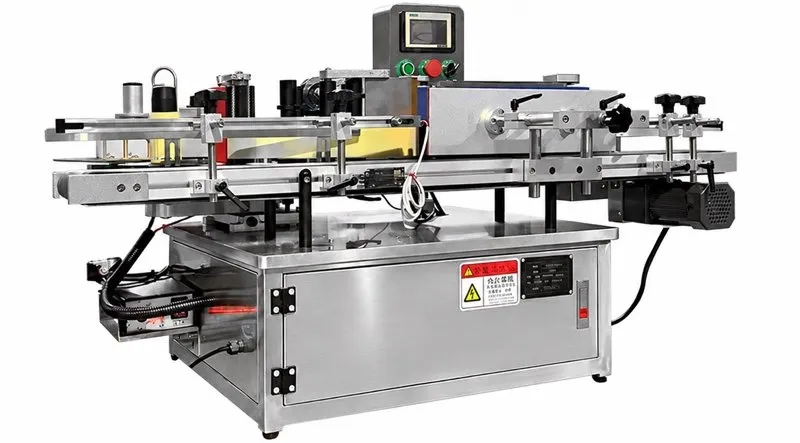
Labeling machine (tabletop)
A labeler listed for flat bottles in cosmetic and skincare packaging.
[06]
We publish no speeds or areas here. They depend on the shampoo, the bottle and the stations.
[07]
We configure and build shampoo lines to order around your shampoo, bottle and closure. The table is the usual starting scope. On site, commissioning runs empty first, then with your shampoo.
Shampoo filling into bottles
Nozzle and fill method configured for the shampoo's foaming.
Capping (screw or flip-top) and labeling
As configured for the closure and bottle shape.
Cap orientation and feeding
Coding and inspection
Pump dispensers with dip tubes and trigger closures
Shampoo blending and storage
Power, compressed air, drains and floor
[Request]
Send a description of the shampoo and how much it foams, the bottle shape and closure, and the bottles per shift you need.