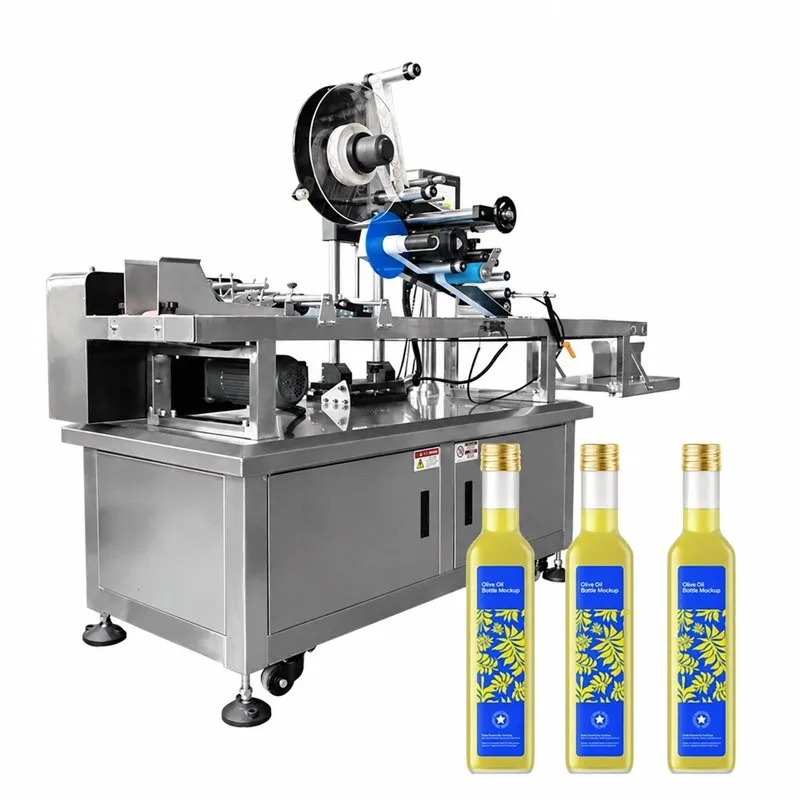
Edible oil bottling line
Labeling stage (flat surface)
Our line page lists liquid filling, capping and multi-side labeling for oil bottles. We go into filler details once we know the oil.

[Filling lines]
Define the liquid and the container first; the filling, capping and labeling stations follow from that.
[01]
Liquids differ more than they look. The same bottle can be easy with one liquid and awkward with another, so start with the product.
| What you know about the liquid | What it changes on the line |
|---|---|
| Thin and free-flowing (water-like, light oils) | Drip after shut-off is the main worry, so drip trays, nozzle shut-off and bottle spacing matter. |
| Slightly thicker (many oils, liquid soaps) | Fill time per container grows with viscosity, and the filler must keep up without splashing. |
| Foams when poured (shampoo, detergents) | Nozzle approach and fill rate are set to keep foam out of the neck. See the shampoo page. |
| Thick or with pieces | Moves toward paste territory. See the paste filling lines page. |
| Hazardous or aggressive (strong acids, solvents, flammables) | We assess these separately. This page makes no claim that we can handle them. |
| Container | Neck opening, height, stability and closure style decide handling, capping and labeling. Drawings or photos with dimensions help. |
[02]
General engineering notes on the common filler types.
| Filler approach | Commonly considered for | Watch points |
|---|---|---|
| Volumetric piston | Liquids from thin to viscous where each container should get a set volume. | Seals and cleaning; the piston, valve and nozzle all touch the product. |
| Pump-driven dosing (for example peristaltic) | Products where a short, simple product path helps cleaning. | Tubing wear; pulsation at the nozzle on some designs. |
| Level-based or overflow filling | Clear liquids in clear bottles where the same fill height looks neat. | Depends on a stable bottle neck and consistent container volume. |
| Gravity-fed filling | Free-flowing liquids at low output. | Sensitive to product level in the tank and to foaming. |
[03]
Capping depends on the closure. A capping head places and tightens screw caps. Flip-top and pump closures need orienting first. Trigger sprayers and pumps with dip tubes are slower to handle, so we look at them case by case.
Labeling follows container shape. Our catalog has wrap-around labelers for round containers, flat-surface labelers for square bottles and flat or oval personal care bottles, and shrink-sleeve lines for full-body coverage. The examples below link to the product pages for specific liquids.
Coding and inspection are options, such as a missing-cap or missing-label check, or a code printed after labeling.
[04]
Two of our product pages relate to liquid lines.
Labeling stage (flat surface)
Our line page lists liquid filling, capping and multi-side labeling for oil bottles. We go into filler details once we know the oil.
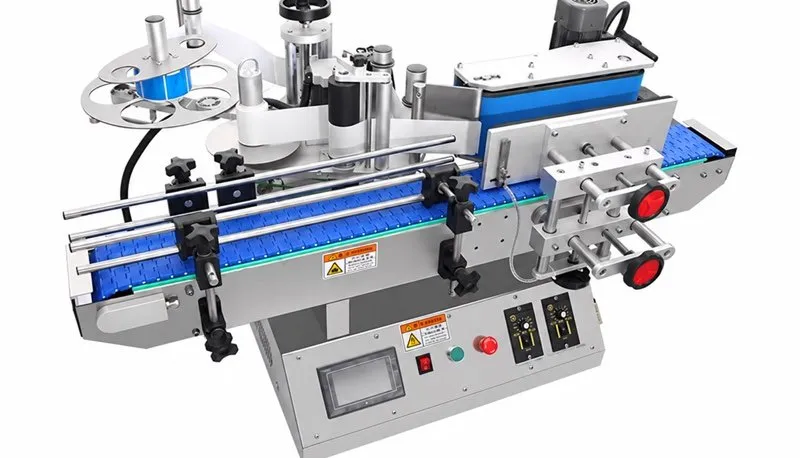
Labeling machine (tabletop)
A labeler for flat and oval bottles, used at the labeling end of a shampoo line.
[05]
We don't publish speeds or floor areas. They depend on the product, the container and the stations you choose, and the proposal states them.
[06]
Anything that touches the liquid has to be cleaned or flushed between products, so more wetted parts mean a longer changeover. Tell us how often you switch products and whether the next one differs in color, fragrance or allergen.
A new bottle changes more than the filler: neck size, height and shape affect nozzle position, capping heads, guide rails and labeling parts, and a new container or label can need new guides or holding parts. If you'll run several sizes, say so at the start and we'll plan for format change.
[07]
These applications have their own pages, each covering what is specific to that product.
[08]
A proposal says what is included, what is optional, what you provide and what sits outside the line. The table is the usual starting point for a liquid line, and every line is configured to your liquid and container and built to order.
Filling, capping and labeling stations
As configured for the liquid and container.
Container feeding or unscrambling
Coding and inspection
Wetted materials and seals for your liquid
Confirmed against the product information you send.
Case packing and palletizing
Bulk storage, blending and product preparation
Power, compressed air, drains and floor
[Request]
Send the liquid, its thickness if you know it, the container and closure, and the output you need per shift.