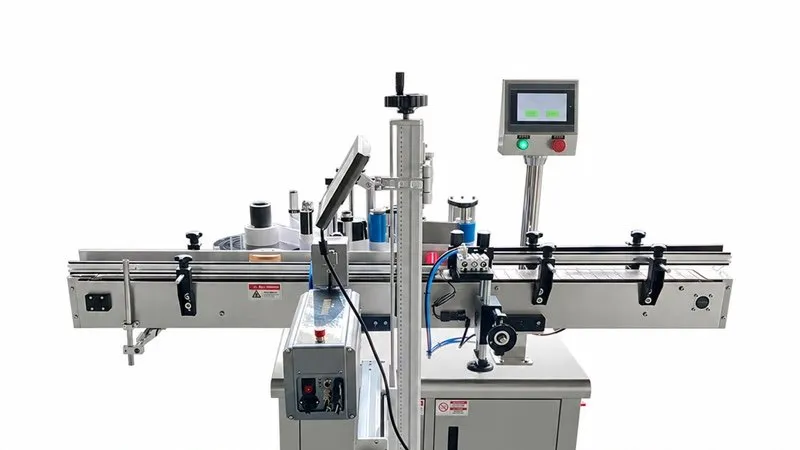
Sauce bottling and labeling line
Labeling stage (wrap-around)
A line page that lists volumetric filling together with labeling for sauce bottles.

[Applications]
Flow behavior and particles set the limits. Describe the sauce and the line is scoped around it.
[01]
A smooth sauce and a chunky one are different projects. Describe your sauce as it leaves the cooking vessel.
| Give us | Why it matters |
|---|---|
| Thickness at filling temperature (pourable, spoonable, or in between) | Sets the dosing type and nozzle size. |
| Particle size and amount: seeds, herbs, vegetable pieces, chili flakes | Decides whether a piston filler can be used and what valve size is needed. |
| Oil content and separation | Oil can settle on the rim, make bottles slippery and spoil label adhesion. |
| Acid level and salt | Affects which wetted materials and seals are suitable. |
| Temperature and how the sauce arrives | Straight from cooking or cooled and stored changes everything about feeding. |
[02]
We don't offer hot-fill by default. Some sauces are filled hot to extend shelf life, which affects container material, closure, cooling and line layout. If your process needs it, tell us and we'll assess it.
Pasteurizing, retorting, shelf-life design, cooking and recipe production all happen outside the line.
The line moves prepared sauce from a feed tank to the container, closes it and labels it. Whether the feed tank needs agitation or heating depends on the sauce.
[03]
Bottles and wide-mouth jars lead to different lines for the same sauce.
| Aspect | Bottle line | Wide-mouth jar line |
|---|---|---|
| Filling | Nozzle sized to the bottle neck; particles are limited by neck diameter. | Wide opening allows larger pieces and thicker sauce. |
| Dripping and rims | Drip control at the nozzle and a clean neck for the cap seal. | A clean rim matters for sealing; sauce on the thread of a jar is common. |
| Capping | Screw, flip-top or press caps, depending on the bottle. | Screw or lug caps; lug caps depend on neck finish and vacuum. |
| Labeling | Wrap-around labeling on round bottles; oil film can affect adhesion. | Wrap-around labeling on curved glass; label tension on tall jars needs care. |
| Container handling | Light plastic bottles can tip on a conveyor. | Heavy glass needs sturdy guides and careful transfer. |
[04]
Our product pages that relate to sauces.
Labeling stage (wrap-around)
A line page that lists volumetric filling together with labeling for sauce bottles.
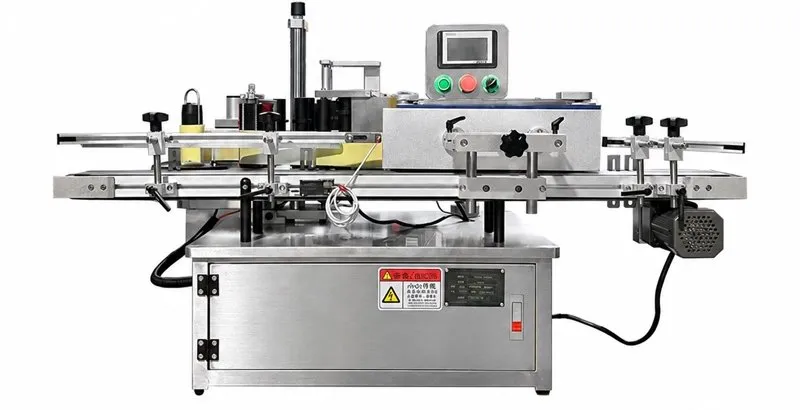
Labeling machine (tabletop)
A tabletop wrap-around labeler for sauce bottles, glass jars and plastic jars. Its page names oil residue as a cause of poor adhesion and lists a pressure-roller system for it.
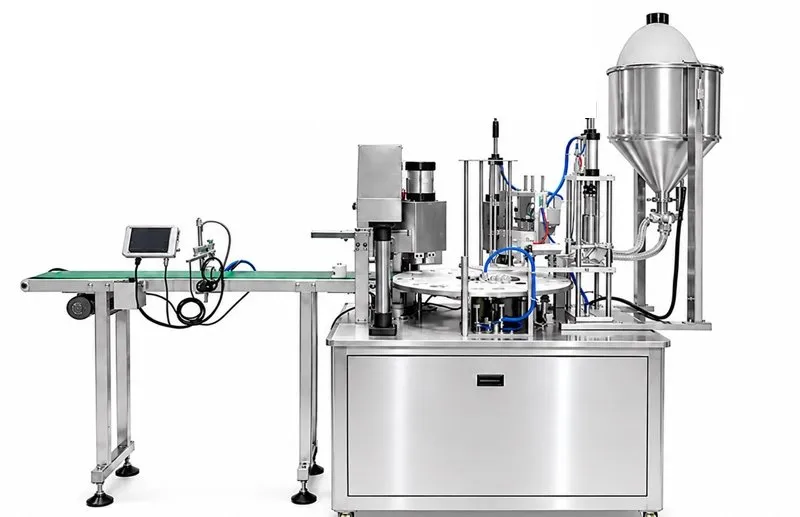
Fill-seal machine (cups)
Fills preformed single-serve cups with servo piston dosing and seals them with foil. For cups, not bottles or jars.
[05]
Agree these before the line is built, so acceptance means ticking off a list.
[06]
Sauce lines are built to order around your sauce and container. The table shows where we usually draw the lines, and the proposal sets the final scope. Hot-fill and large pieces stay open until we've seen your process.
Sauce filling into bottles or jars
Filler configured for the sauce and its particles.
Capping and labeling
As configured.
Container feeding or unscrambling
Hot-fill temperature handling
Not offered by default; we assess it if you need it.
Sauces with large pieces
Cooking, pasteurizing and recipe production
Utilities and room preparation
[Request]
Send a description of the sauce, the size of any particles, the container and the output you need per shift.