
[Buying guides]
Volumetric vs Net Weight Filling: Which Quantity Must Each Bottle Hold?
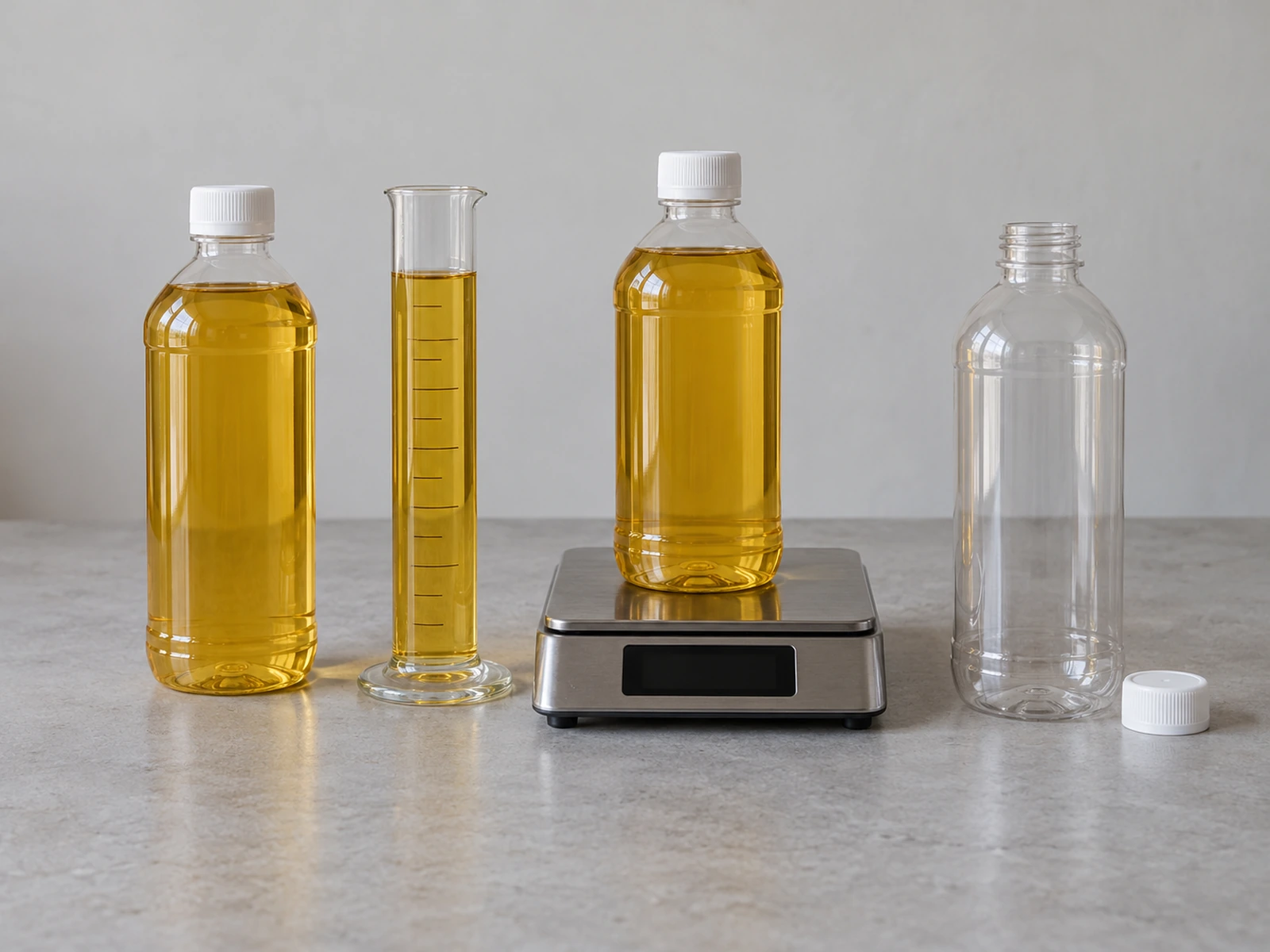
If two filling proposals control different quantities, their accuracy claims cannot be compared, and the wrong method can end up on your line. Decide whether each bottle or jar must hold a stated volume or a stated net product mass, then compare how each proposal controls and checks that quantity. This guide gives you a target-unit matrix and two blank records; the photo shows a volume cue, a weight cue and an empty container for tare, as an illustration of the comparison rather than a machine.
Updated October 2026
Quick View: Six Items to Fix Before Comparing Methods
Scroll across to read all three columns.
| Item | Where it comes from | Why it matters |
|---|---|---|
| Target unit | Your label, specification or customer contract, for example mL or g per container | Decides whether the filler must control volume or net product mass. |
| Controlled quantity | Each proposal's metering method: piston, pump, flow meter or scale | Shows whether the dose is set as a volume or as a mass. |
| Container tare | The empty bottle or jar, weighed with the same parts as the filled one | Net product mass is the filled weight minus this tare. |
| Density and temperature | Your product data at a stated temperature, or marked unknown | The only link between a volume result and a mass result. |
| Apparent liquid level | A visual check of the filled container | Records appearance; it does not measure volume or mass. |
| Independent check method | Each proposal: instrument, quantity checked and conditions | Lets you compare results measured the same way. |
Volumetric or Net Weight: Which Quantity Must Each Bottle Hold?
A volumetric filler dispenses a set volume, usually with a piston or a pump. A net weight filler weighs the product as it enters the container and stops at a target weight. Choose by the quantity each bottle or jar has to hold. A stated volume calls for volume control and a volume check; a stated net product mass calls for mass control and a mass check with the container tare taken off. The supplier sources we read rank the two methods differently, and none of those rankings covers every product: the result depends on the product, the container and the equipment proposed.
If you are holding two quotations that meter the product differently, this guide is for that comparison and nothing wider. It does not choose pumps or rank suppliers, and the wider selection steps are in how to choose a filling line.
Takeaway: Write down the target unit before you ask anyone which filling method to use.
Choose the Target Unit First
Start from what the finished pack has to satisfy, then read across. Each row names the quantity the filler has to control, the conditions to write down and what to ask each proposal for.
| Target requirement | Quantity to control | Conditions to record | Evidence to ask each proposal for |
|---|---|---|---|
| A stated volume per container | Volume, with a volumetric dose (piston or pump) or a flow meter that measures volume | Product temperature at filling and at the check; any foam or trapped air | How the dose volume is set, and how the volume in a filled container is checked |
| A stated net product mass per container | Net product mass, with a scale under the container or a mass flow meter | Container tare basis; closure on or off at weighing; product temperature | How tare is taken, which instrument checks net mass, and how a mass-flow dose is verified |
| An even visible fill level only | Fill height in each container | Container dimensions and the level you expect to see | An agreed volume or mass as well, because a level does not state the content |
| Both a volume and a net product mass | One quantity controlled, the other checked | Product density at a stated temperature, or unknown if nobody has measured it | Both checks, and the density basis used to connect them |
Takeaway: The target unit decides the method and the check; the machine type follows from it.
What to Send Us About Your Target Unit
Send these items in one WhatsApp message and write unknown where you have no figure. We reply within 24 hours.
| Item | Why we need it | Example format |
|---|---|---|
| Target amount and unit | Sets whether the line controls volume or net product mass | ___ mL or ___ g per container |
| Controlled quantity | Shows which quantity your label or contract fixes, and whether an even level also matters | Volume / net product mass / both; even level needed: yes or no |
| Product | Product behavior decides which metering methods are possible | Product name; foams or carries air: yes / no / unknown |
| Filling temperature | Volume changes as a product cools | ___ °C at filling; ___ °C at the check, or unknown |
| Density | Links a volume result to a mass result | ___ g/mL at ___ °C, or unknown |
| Container | Container shape changes the visible level and the tare | Bottle or jar photo or drawing; empty weight if known |
| Closure | Decides what the tare has to include | Cap type and size; liner or inner seal: yes / no |
Takeaway: The target amount with its unit comes first; everything else tells us how to control and check it.
Volume, Net Product Mass and Fill Level Are Different Readings
Volume is the space a dose takes up, stated in mL or L. A volumetric filler sets it through the stroke of a piston or the delivery of a pump. To check it, measure the volume of a filled container and record the product temperature at the time.
Net product mass is the weight of the product alone, stated in g or kg. A net weight filler sets it with load cells or a scale under the container and ends the fill at the target weight. To check it, weigh the filled container and subtract the container tare.
Fill level is where the liquid surface sits in one particular bottle. It is what a shopper sees, and level or overflow fillers work to it, yet it measures neither volume nor mass.
Flow meter fillers sit on either side. Supplier material describes magnetic flow meters that measure volume and mass flow meters that measure mass, so a mass flow filler can control net product mass with no scale under the container. Ask which meter a proposal uses before you file it as volumetric. Product behavior can also rule a method out, so read the liquid filling lines page for how we match filling technology to thin products.
Takeaway: For each proposal, note which reading it controls and which ones it only shows.
Why Equal Volumes Can Sit at Different Levels
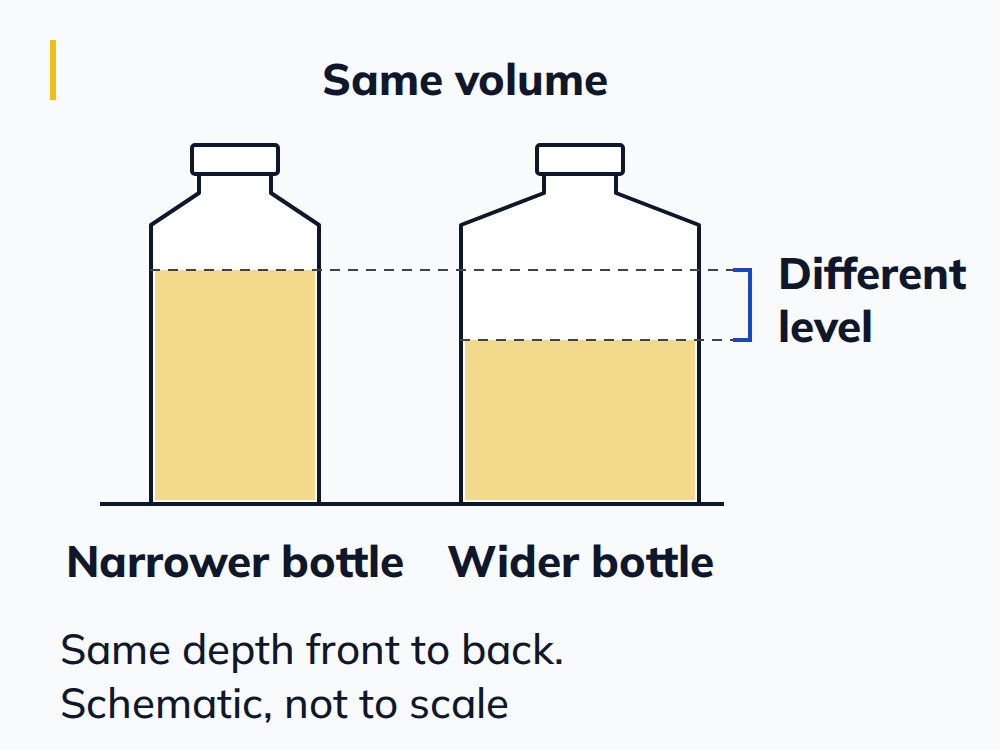
Two bottles can hold the same volume and still show different levels, because small differences in container dimensions change where the surface ends up. Supplier explanations of volumetric filling say as much: the dose stays consistent while the containers look unevenly filled.
Treat the visible level as an appearance check. If your customer expects an even line on the shelf, record the level as its own item next to the agreed volume or mass, and do not judge content by it. Our sauce line acceptance table starts the same way, with the fill quantity and how it will be measured.
Takeaway: Record the level separately; it shows how a pack looks, not what it holds.
How Tare Turns a Scale Reading into Net Product Mass
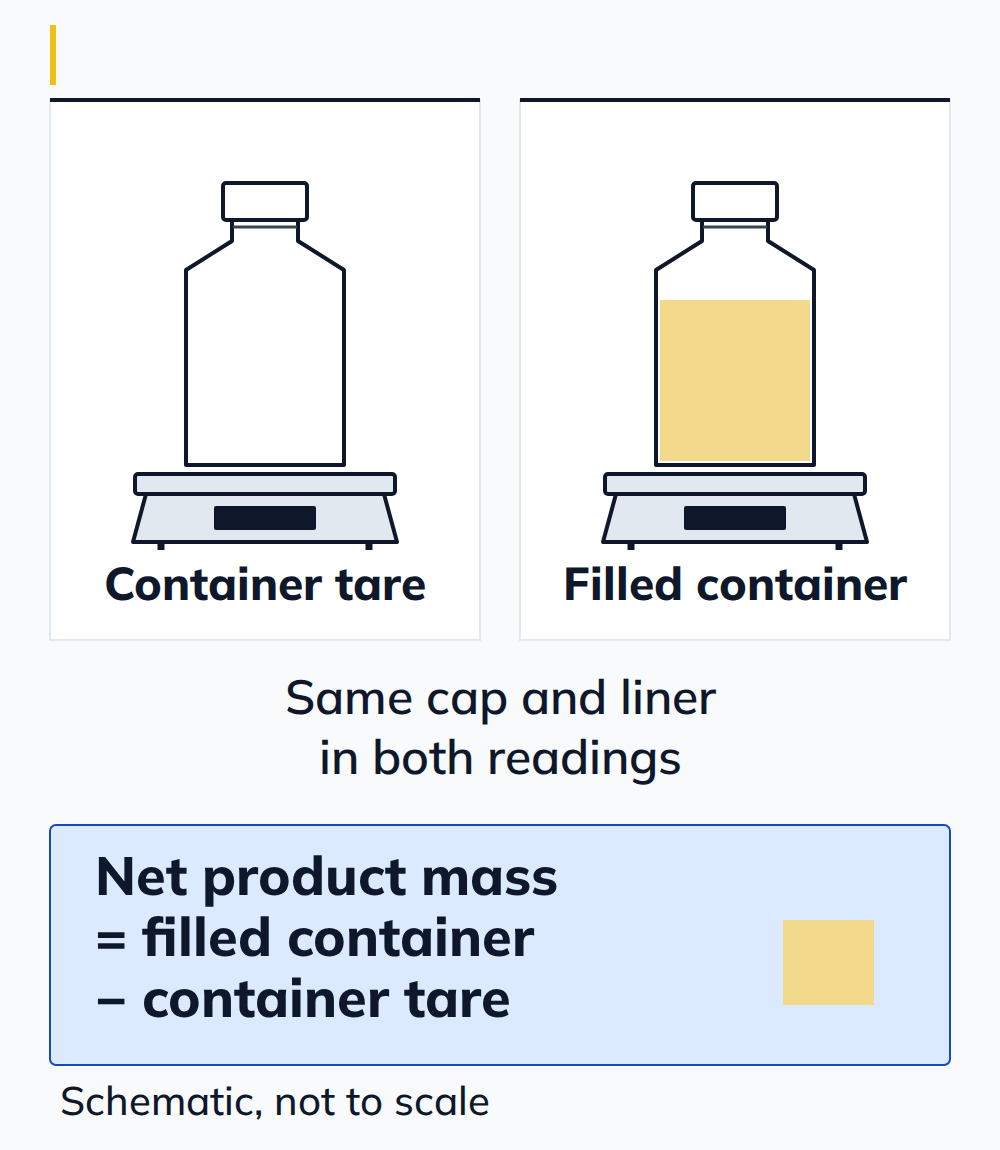
A scale under a filled container reads the product plus the container. Net product mass is that filled-container reading minus the container tare, the weight of the empty container. A supplier's checkweigher example for jars describes the same subtraction: the jar weight is taken off so the reading shows the product inside.
The subtraction only holds when both readings include the same parts. If the cap and liner are on at the filled weighing, weigh the empty container with a cap and liner too, or take both readings without them. Also write down whether the tare is weighed for each container or taken as an agreed value, because that choice changes what the net result means.
A mass flow filler measures the product before it reaches the container, so the dose itself needs no tare. Some plants still add a checkweigher after it to verify the dose, and that check needs a tare again.
Takeaway: Weigh the tare with the same parts that will be on the container at the net-mass check.
Record Density, Temperature and Air Before You Compare
A volume result and a mass result describe the same dose only through the product's density, and density changes with temperature. Write these conditions into every comparison.
- Product density, with the temperature it applies to. If nobody has measured it, write unknown instead of assuming the product weighs the same as water.
- Temperature at filling and at the check. A product filled hot contracts as it cools, so the same mass takes up less volume by the time it is checked. Our honey and edible oil pages explain why filling temperature matters for those products.
- Foam or trapped air. Air in the dose reads as extra volume to a volume measurement, so note whether the product foams at the filling temperature. The shampoo filling lines page covers foaming products.
- Common mistake: Comparing a volume result from one proposal with a mass result from another, with no density figure at a stated temperature.
- Takeaway: Write the temperature next to every density, volume and mass figure.
Compare Two Filling Proposals on the Same Basis
Copy this record and fill one column per proposal from its written offer. Leave a cell blank when the offer does not say; each blank is a question to send back. For everything else a quotation should cover, use the RFQ checklist, and compare prices only once the scope matches, as the filling line cost guide explains.
| Recorded item | Basis or conditions | Proposal A | Proposal B |
|---|---|---|---|
| Target amount and unit | Your requirement, for example mL or g per container | ||
| Controlled quantity and device | Volume or mass; piston, pump, flow meter or scale | ||
| Volume result | Measured at a stated product temperature | ||
| Net product mass result | Filled-container mass minus container tare | ||
| Container tare basis | Weighed per container or agreed value; cap and liner on or off | ||
| Apparent liquid level | Visual, recorded apart from the content | ||
| Product batch and container format | Batch reference; bottle or jar and closure | ||
| Density and its temperature | Measured value and the temperature it applies to, or unknown | ||
| Temperature at filling and at the check | Product temperature at both points | ||
| Independent check method | Instrument, quantity checked and who performs the check | ||
| Agreed criterion | Set by buyer and supplier together; this guide gives none |
Takeaway: Get the blank cells answered by each supplier before you compare accuracy or price.
A Blank Record for Each Check
Once both parties agree how the quantity will be checked, give each container one row. The columns hold the six quantities this comparison depends on. Write the unit with every value.
| Container or run reference | Volume | Net product mass | Apparent liquid level | Container tare | Density and temperature conditions | Independent check method |
|---|---|---|---|---|---|---|
| Container 1 | ||||||
| Container 2 | ||||||
| Container 3 |
Add rows to match the check you agree; three rows are only a starting layout, not a recommended count. Takeaway: Agree the check method first, then record every container in the same layout.
When This Comparison Does Not Settle the Choice
- The metering basis does not set line output. A line runs at the rate of its slowest or most stop-prone station, which the line layout review looks at across the whole line.
- Product behavior can rule a method out before the target unit matters. Thick, stringy or particle-filled products need their own review, described on the paste filling lines page.
- A catalog accuracy or speed figure describes the conditions it came from. Supplier pages themselves say actual performance depends on the filling technology, the product, the target amount, product supply and machine configuration.
- Labeling rules are outside this guide. If a regulation or a customer specification fixes the declared unit, that document sets your target unit, and this guide helps you check against it.
- Common mistake: Picking a method from a general ranking, then finding the label states the other unit.
- Takeaway: Settle the metering basis here, then check output and layout for the whole line.
Method and Sources for This Comparison
We compiled this guide from public sources read between 6 and 11 October 2026. Supplier articles explaining volumetric, net weight and flow meter filling carried dates from 29 March 2024 to 11 June 2026; one of them, updated 17 August 2025, was written for pails, drums and totes rather than bottles. Two supplier catalog pages, one on net weight fillers for bulk and high-value products and one on pail fillers, showed no date. The tare example comes from an undated supplier page about a checkweigher for herb jars, not a liquid filler. Our own packaging-line planning guidance is linked under Sources below.
We took definitions and the conditions that change a result from these sources. We did not reuse their accuracy figures, speed rankings or legal advice, because those were written for other containers and set-ups. The matrix and both records are our planning aids. They are not an industry standard and contain no test results of ours. More planning guides are collected on the buying guides page.
[Sources]
- Our packaging-line planning guidance: define formats, operating conditions and acceptance measurements, and compare units on the same product and pack. linevopack.com/solutions
Common Questions About Volumetric and Net Weight Filling
- 01Can gross weight and net weight be the same?
- Not for a filled bottle or jar: gross weight is the filled container and net weight is the product alone, so they differ by the container tare. A scale tared with the empty container on it displays net weight directly, which is why net weight fill cycles tare or zero the scale each time.
- 02Is net weight the same as fluid ounces?
- No. Net weight is the mass of the product without its container, and fluid ounces measure volume. Moving between the two needs your product's density at a stated temperature, so use a measured density instead of assuming water, and fill to whichever unit your label or contract states.
- 03What are the different types of filling machines?
- Grouped by what they control: piston and pump fillers set a volume, scale-based fillers set net weight, flow meter fillers set volume or mass depending on the meter, and level or overflow fillers set a fill height. If a proposal uses level filling while your label states a volume or mass, ask how that quantity will be checked separately.
- 04How much does a liquid filling machine cost?
- No single price fits every line, because the metering method, the product and the stations around the filler all change it. Compare quotations only after both meter the same target unit, then use the filling line cost guide to match the rest of the scope.
- 05What should I check for a small net weight filling machine?
- Ask for evidence on your own bottle and target amount rather than a catalog figure. Several of the supplier sources we read were written for pails, drums and bulk containers, so a small bottle needs its stated format, target unit, tare basis and an independently checked result for that set-up.
- 06How should I compare a manual net weight setup with an automatic bottle line?
- Compare them in two steps. First check that both control and verify the same target unit with the same tare basis. Then compare which stations stay manual and the output of the whole line, which the semi-automatic bottle filling line guide covers station by station.
[Request]
Send Your Target Unit and Product Details
Send the target amount with its unit (mL or g), the quantity your label or contract fixes, the product, the filling temperature, any known density, the bottle or jar and the closure, as listed in the table near the top of this guide. Mark anything you do not know as unknown. We reply within 24 hours. The reply lists the questions that decide whether your line should control volume or net product mass, and how that quantity should be checked.
We reply within 24 hours.
[Keep planning]
- How to Choose a Filling LineBuying a line by its fastest machine misses the capper, labeler or loading step that really sets output. Work from the product and container to the good output you need, then set the automation boundary, check the space and agree the scope.
- RFQ ChecklistLeave the product, container or station list out of an inquiry and each supplier ends up quoting a different line. Prepare the twelve items below once, send them in one WhatsApp conversation, and write "not decided" where a value is still open.
- Filling Line CostComparing two filling line totals before their scope matches can hide a missing capper, conveyor or installation that you pay for later. Match the scope first, then compare the totals.
- Line LayoutA line placed before the room, the way in and the operator routes are checked often has to be moved after delivery. Record the product, container and stations first, then check the route in, operator and maintenance access, and material movement.