
[Buying guides]
Piston Filler vs Gear Pump Filler Difference on a Bottle Line
A gear pump is a subclass of pump. A quotation that only says piston filler or gear pump filler still has to name the valve, the seals, the refill motion and the bottle-control interface. Fill in the record on this page before you place the order.
Updated October 2026
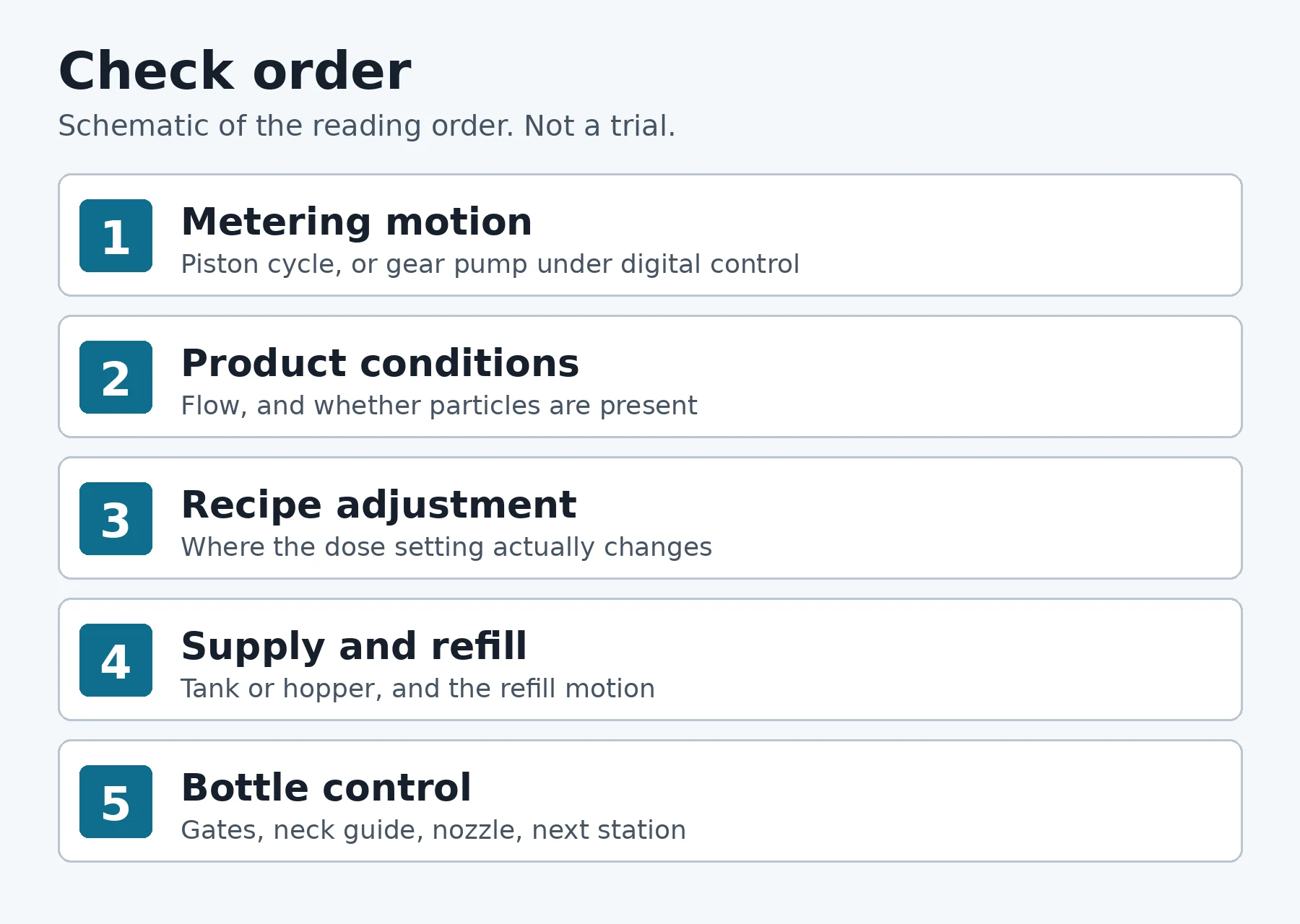
Quick View: Five Checks Before the Pump-Type Name
Scroll across to read all three columns.
| Check | Write down | Ask the quotation to name |
|---|---|---|
| 1. Metering motion | Piston cycle, or gear pump under digital control | Piston and cylinder, or the gear pump, plus the valve |
| 2. Product conditions | How the product flows, and whether particles are present | Which named parts the product touches. Particles stay open. |
| 3. Recipe adjustment | The dose you need to change | Where the dose is set: each pump, gear speed, or each piston |
| 4. Supply and refill | Where product sits before the dose | Tank or hopper, fittings, and the parts that come apart |
| 5. Bottle-control interface | How bottles enter, stop and leave | Gates, neck guide, nozzle motion, and any capper or labeler |
Check the Metering Motion First
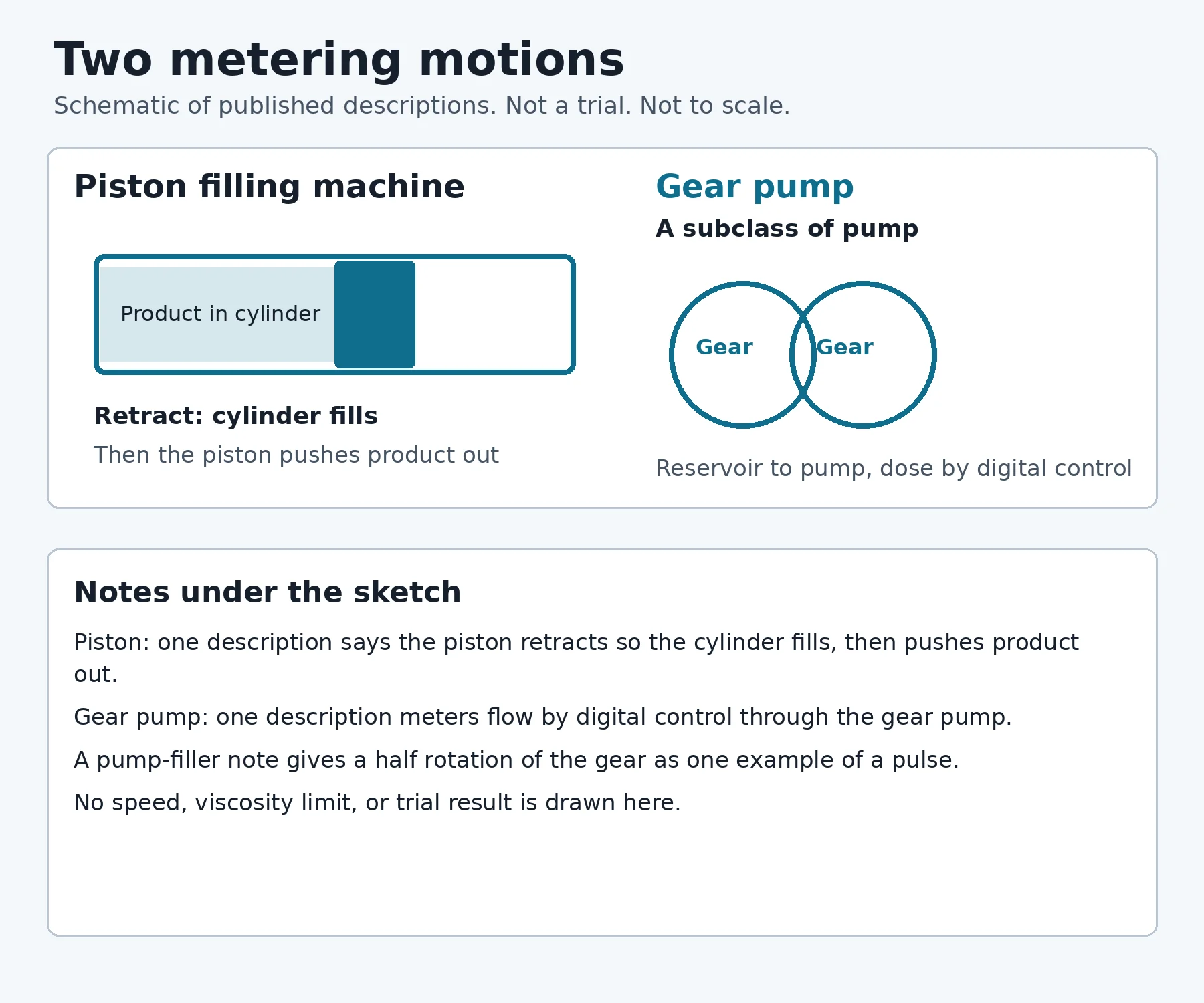
The piston filler vs gear pump filler difference that matters on a bottle line is which motion the quotation is selling. One description of a piston filling machine says each cycle the piston retracts so the cylinder fills with product, then the piston pushes that product out of the cylinder into the container. A gear pump filling machine, in another description, meters liquid by digital control: product leaves a reservoir through the gear pump, and the PLC sets the volume. A pump-filler explanation places the gear pump inside pump filling, and gives a half rotation of the gear as one example of a pulse.
A gear pump is a subclass of pump. Ordering a gear pump filler is ordering one kind of pump filler, and the quotation still has to name that pump, the valve, the seals and the parts that come apart for cleaning.
The sentences above come from supplier pages fetched or retrieved in October 2026. They describe motions. They are not a trial of your product. The drawings on this page are schematics of those descriptions.
Common mistake: Placing the order from the words piston filling machine or gear pump filling machine while the valve, the seals and the cleaning parts are still unnamed.
Takeaway: Read the metering motion in the quotation before you treat the pump-type name as the order.
Quote Record: Principle, Parts, Motion, Proof
Copy one row set per quotation. Leave a cell blank when the quotation is silent, and send the blank back. The last three rows stay open until the supplier says how particles, shear and wear will be evaluated.
| Principle | Parts | Bottle-control or refill motion | Condition the supplier must prove |
|---|---|---|---|
| Piston cycle: the piston retracts and the cylinder fills, then the piston pushes product out. One description says the cylinder interior does not change. That is an account of the motion. | Piston, cylinder, the valve on that path, and the seals. | Refill is the retract that fills the cylinder. One piston-filler page also describes no-bottle-no-fill, and a nozzle held above the mouth or moved on a bottom-up path. | Name the valve, the seals, and how the cylinder refills at your dose. A sales line about accuracy is not that naming. |
| A gear pump is a subclass of pump. Digital control meters flow through the gear pump from a reservoir. One pump-filler note gives a half rotation of the gear as an example of a pulse. | Gear pump, valve, seals, and the clamps or fittings that let the pump come apart. One page says two tri-clover clamps release the pump, and that seals or hoses can be ordered for that machine. | Supply runs from the reservoir through the pump. The same page describes indexing gates at entry and exit, a neck guide, and no-container-no-fill. | Name the pump, the valve, the seals, the parts that unclamp, and the volume setting for each pump. |
| A dose change is a setting on the piston or on the pump, in the place the quotation points to. | The screen or PLC, plus the adjustment for each piston or each pump. One gear-pump page says a servo sets gear speed and the touch screen sets filling capacity. | A recipe change is separate from the bottle gate and from the nozzle lift. | Show where the dose is changed, and whether each piston or each pump is set on its own. |
| The metering device moves only product that has already reached it. | Hopper or reservoir, pipes, fittings and valves. One piston catalog lists a buffer tank, a direct draw, or recirculation as ways to feed the pistons. | Piston: the cylinder fills on the retract. Gear pump: product flows from the tank through the pump during the dose. | Name the supply path and every part that comes apart for cleaning. |
| A line runs at the rate of its slowest station under your conditions, so the pump-type name does not set the line rate. | Entry and exit gates, neck guide, nozzle carrier, and any capper or labeler this quotation includes. | Gates and nozzle motion sit beside the metering cycle. One gear-pump page lists a capping machine and a labeling machine as optional, on a page that also prints two model names in one specification table. | State what the machine does when no bottle is present, whether the nozzle moves down into the bottle, and which machine any capper or labeler belongs to. |
| Particles: still to evaluate. A pump-type name does not prove how particles will pass. | The product-contact parts named in the rows above. A wide product list on one gear-pump page is not evidence for every gear pump. | Piston and valve travel, or gear rotation, is the motion to assess. | The supplier states how particles will be evaluated on your product. This page sets no particle-size limit. |
| Shear: still to evaluate, for gear rotation and for the piston stroke. | Valve, pump or piston, and seals. | Gear rotation, and the piston stroke with its valve, are the motions to assess. | The supplier states how shear will be evaluated on your product. |
| Wear: still to evaluate. | Seals, and the pump or the piston, cylinder and valve. | The motion that repeats on every dose. | The supplier states how wear will be evaluated and which parts are replaced. This page states no wear life. |
Takeaway: A blank cell is a question. Particles, shear and wear stay marked still to evaluate.
Two Metering Motions, Drawn as a Schematic
The left sketch follows the piston description: the piston retracts, the cylinder fills, then the piston pushes product out. The right sketch follows the gear-pump description: a reservoir feeds a gear pump, and the dose is under digital control. A gear pump is a subclass of pump, so the right-hand sketch is one pump.
Takeaway: Use the sketch to see the two motions. Use the table to see what the quotation must name.
Write Down Product Flow and Particles
Write how the product flows at the temperature you fill it, and whether particles, seeds, pieces or fibers are present. If you do not know, write unknown. Those notes tell the supplier which row of the record to answer. They do not pick a filler by themselves.
This page does not publish a viscosity cutoff or a particle-size limit. A recommended-product list on one gear-pump page covers many foods and creams, and the same page mixes two model names in its specification table. That list does not prove particle handling for every gear pump.
The paste filling lines page is where we ask how a thick product is fed and cleaned. Bring the same product description here when the quotation has already named a piston or a gear pump.
Takeaway: Record flow and particles as facts about your product. Leave the evaluation mark on the particles row until the supplier answers it.
See How the Dose Setting Changes
One piston page, fetched 8 October 2026, describes a servo-driven in-line piston filling machine under a PLC and a touch screen, with individual piston adjustment and a digital volume change. One gear-pump page fetched the same day says filling capacity is adjusted on the touch screen and a servo controls gear speed. Another gear-pump page, dated 15 May 2021 and fetched 8 October 2026, gives each pump its own volume adjustment and stores recipes on the PLC and HMI.
Treat those as examples of places a quotation can point. Do not copy speeds, fill ranges or accuracy figures from those pages onto your order. The gear-pump page that mentions servo gear speed prints two model names in one specification table, so a figure in that table is not tied to one machine here.
Takeaway: Ask which control changes the dose, and whether each piston or each pump has its own setting.
Parts the Quotation Has to Name
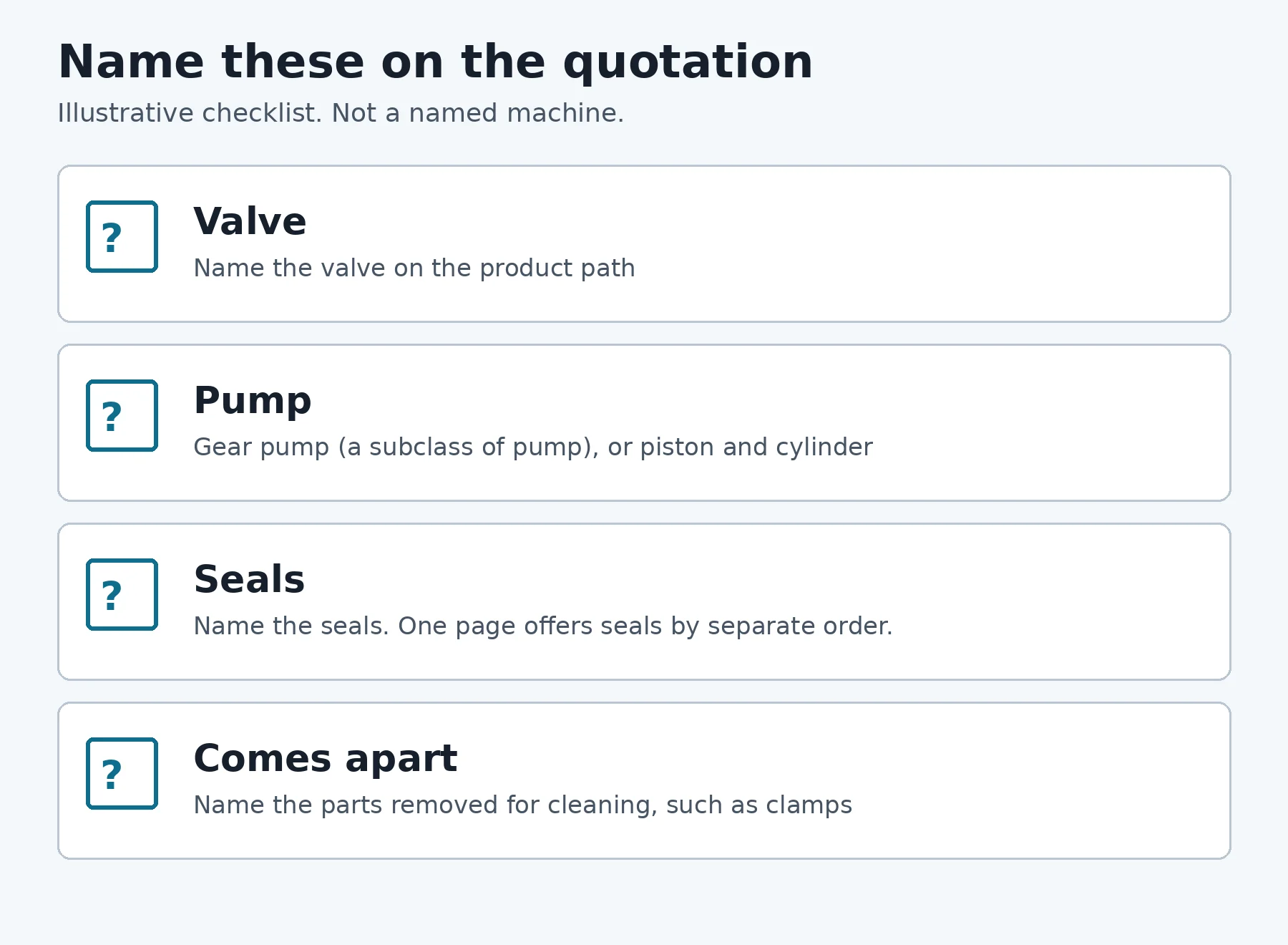
The quotation should name four things even when the title already says piston filling machine or gear pump filling machine: the valve, the pump (or the piston and cylinder), the seals, and the parts that come apart for cleaning.
On the gear-pump page dated 15 May 2021, product-supply connections, pipes, fittings and valves use sanitary tri-clamp fittings, the pump comes apart when two tri-clover clamps are removed, and seals or hoses are by order. Product-contact parts on that page are listed as stainless steel, Teflon and Viton. Ask your supplier to name the materials on your machine. That list belongs to that page.
Takeaway: If the quotation skips one of the four boxes, the pump-type name is not enough to order.
Supply Path, Refill and Bottle Control
On the piston side, a catalog retrieved 11 October 2026 says the piston draws product from a hopper into a cylinder and that the stroke is adjustable. The same page lists three feed arrangements: a buffer tank with a level-sensing float, a manifold with direct draw, or recirculation. The page is headed as a piston filling machine and, in the same product line, also names a gear pump filling machine. The heading does not tell you which feed, or which pump, is in the quotation.
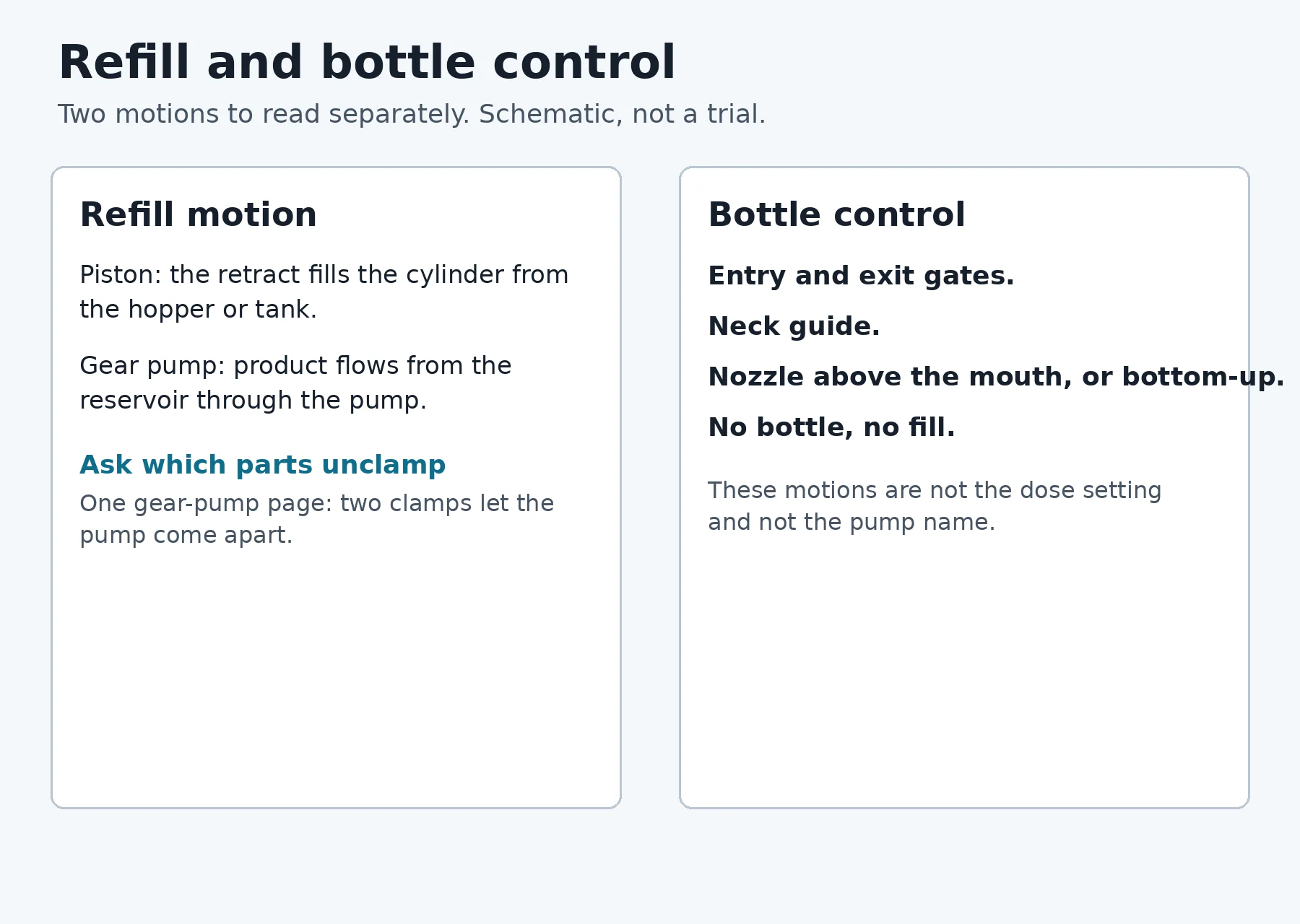
On the gear-pump side, the 15 May 2021 page says liquid flows from the reservoir through the gear pump. Refill for the piston is the retract that fills the cylinder. Refill for the gear pump is flow from the tank through the pump. Write the one your quotation uses.
Bottle control is the other motion. That gear-pump page describes indexing control with adjustable entry and exit gating cylinders, a container neck guide, and no-container-no-fill. The nozzle carrier can fill from the top or bottom-up, with the vertical motion on a servo. The piston page describes a nozzle lift set from the touch screen, either above the bottle mouth or bottom-up, and a no-bottle-no-fill interlock.
A line produces at the rate of the station that runs slowest under your conditions, and a component specification does not by itself describe the output of the whole line. If you already run a station and the question is which job to take off hand work, the semi-automatic bottle filling line guide walks the stations. This page only asks the quotation to name the bottle-control interface on the filler.
One public gear-pump page lists a capping machine and a labeling machine as optional. The specification block on that page shows two model names. The quotation has to say which machine those options belong to.
Takeaway: Write the supply path, the refill motion and the bottle-control interface on three separate lines of the record.
Refill Beside Bottle Control
Read the left panel as the path that refills the meter, and the right panel as the way bottles are gated and the nozzle is placed. A quotation can describe one and stay silent on the other.
Takeaway: Gates, a neck guide and a nozzle lift are bottle control. They are not a substitute for naming the pump and the valve.
Particles, Shear and Wear Are Still Open
Particles, shear and wear are marked still to evaluate in the record. Public comparisons already discuss lubricity, particles, shear and cleaning in general terms. Repeating that discussion would not tell you which parts are in this quotation.
We do not set a particle size, a viscosity number or a wear life here. Send the product behavior you have, and ask the supplier to say how those three items will be evaluated, and on which of the named parts.
Takeaway: Keep the three rows open until the quotation says how each one will be evaluated.
What This Check Does Not Decide
We use this page for one decision: whether a quotation that says piston filler or gear pump filler has named the valve, the pump, the seals, the parts that come apart for cleaning, the refill motion and the bottle-control interface.
Choosing the rest of the line sits in how to choose a filling line. The full inquiry list is the filling line RFQ checklist. Whether each bottle must hold a stated volume or a stated net mass is volumetric vs net weight filling. Overflow filling is outside this record.
Takeaway: Finish this record, then use the line guide and the RFQ checklist for everything else the order needs.
Method and Sources
Supplier pages were read from copies fetched on 8 October 2026 and from pages retrieved on 11 October 2026. Where a copy carries its own date, that date is given with the fetch date. Model numbers, speeds, fill ranges and accuracy percentages on those pages are left out. One gear-pump specification table mixes two model names, and the piston page's accuracy wording is a sales claim.
The drawings are schematics of the motions and the quote fields. They are not a photograph of a machine and not a record of a trial.
Our planning page, retrieved 11 October 2026, is the source for the slowest-station point and for the statement that a component specification does not describe a complete line. We build filling lines to order. The supplier machines cited above are not a catalog we sell.
[Sources]
- Pump-filler explanation retrieved 11 October 2026. Places a gear pump inside pump filling and gives a half rotation of the gear as one example of a pulse. Describes a piston cycle as a retract that fills the cylinder, then a push out of the cylinder. www.liquidpackagingsolution.com/news/packaging-systems---the-filling-phase
- Gear-pump filler page dated 15 May 2021, fetched 8 October 2026. Digital metering through a PLC, a volume setting per pump, recipes on the HMI, sanitary valves and fittings, seals or hoses by order, a pump that comes apart at two clamps, and indexing bottle gates. Speeds and pump sizes on that page are not used here. dtmpackaging.com/machines/filler/purefil-in-line-fillers/
- Gear-pump filler page fetched 8 October 2026. Servo control of gear speed and filling capacity set on the touch screen. A capping machine and a labeling machine are listed as optional. The specification table on the same page shows two model names, so its figures are not used. www.landpacking.com/product/filling-machine/high-precision-gear-pump-bottle-filling-machine-for-liquid.html
- Piston filling machine page fetched 8 October 2026. In-line servo-driven volumetric piston, PLC and touch screen, individual piston adjustment, digital volume change, no-bottle-no-fill, and a nozzle above the mouth or on a bottom-up path. Sales wording on accuracy is not treated as a test. www.jpacks.com/Product/JPF-Series-Automatic-Bottle-Liquid-Piston-Filling-Machine.html
- Catalog page retrieved 11 October 2026, headed as a piston filling machine, which also names a gear pump filling machine in the same product line. The piston text describes a draw from a hopper into a cylinder, an adjustable stroke, and three feed arrangements. www.multipackmachinery.com/piston-filling-machine/
- Our packaging-line planning page, retrieved 11 October 2026: a line produces at the rate of its slowest station under the real conditions, and a component specification does not by itself describe the output of the combined line. linevopack.com/solutions
Questions About the Quote Record
- 01Is a gear pump a pump?
- Yes. A gear pump is a subclass of pump. One pump-filler explanation uses a gear pump as its example and describes a pulse as a half rotation of the gear. The quotation still has to name that pump, the valve and the seals.
- 02What should a piston filler or gear pump filler quotation name?
- The valve, the pump or the piston and cylinder, the seals, the parts that come apart for cleaning, the refill motion, and the bottle-control interface. Particles, shear and wear stay on the record as items still to evaluate.
[Request]
Send Flow, Dose, Container and the Station
Send four items in one WhatsApp message: how the product flows and whether particles are present, the dose, the container, and a description of the station you already have. Write unknown where a fact is missing.
We reply within 24 hours.
[Keep planning]
- Paste Filling LinesAir and stringing in a paste end up as short fills and dirty seals. Tell us how your product behaves at filling temperature and we configure the feed, dosing and sealing around it.
- How to Choose a Filling LineBuying a line by its fastest machine misses the capper, labeler or loading step that really sets output. Work from the product and container to the good output you need, then set the automation boundary, check the space and agree the scope.
- RFQ ChecklistLeave the product, container or station list out of an inquiry and each supplier ends up quoting a different line. Prepare the twelve items below once, send them in one WhatsApp conversation, and write "not decided" where a value is still open.
- Semi-Automatic Bottle LineIf you already fill bottles with a semi-automatic bottle filling machine, the next question is which station to automate. This guide takes each station in turn, says when it can stay manual and what tells you to automate it, and suggests an order that lowers the risk of reworking the handovers between stations later.