
[Buying guides]
Can Filling Machine and Seaming Line Configuration Guide
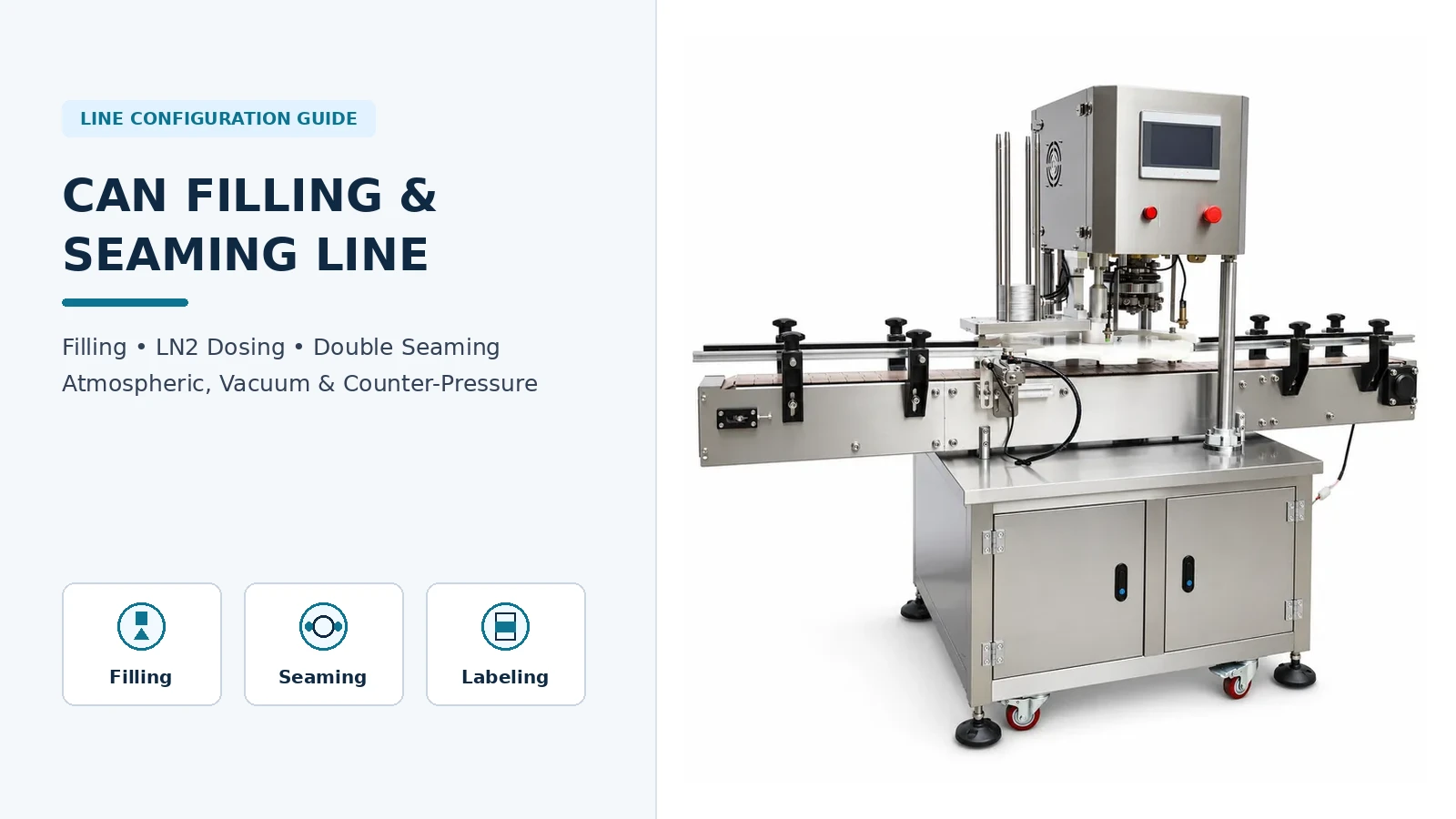
A complete canning line pairs a can filling machine with an atmospheric, vacuum, or nitrogen-flushed can seamer and a downstream can labeling machine so fill volume, headspace oxygen, double-seam hooks, and label placement stay synchronized.
Updated November 2026
Can Filling Machine Architectures: Atmospheric Flowmeter vs Counter-Pressure Isobaric
Choosing a can filling machine starts with whether the product is a still liquid metered at ambient pressure or a carbonated beverage that must remain under counter-pressure until the liquid valve closes.
We integrate high-pressure isobaric filling with high-speed precision labeling on carbonated soft drink lines, developing the equipment configuration, tooling, and integration around your product, pack format, and production requirements.
For broader bottle and can liquid dosing comparisons across still and carbonated liquids, review our liquid filling lines pillar overview.
For still and low-carbonation craft beverages, open-air magnetic flowmeter fillers provide repeatable fill volume control using proprietary magnetic flowmeter technology capable of 1 ml precision input by the operator on the HMI, hygienic with no moving parts.
An open-air craft canning configuration provides continuous operation at speeds of up to 100 containers per minute (CPM) across a variable speed range of 30-100 CPM with twelve filling heads.
To limit oxygen pickup before closure on open-air lines, sanitary 316 stainless steel CO2 pre-purge nozzles located directly behind filling heads limit the distance of travel from pre-purge to filling to only 1 can body diameter for all heads, paired with a CO2 gassing tunnel between the filler discharge and lid application.
When carbonation levels require counter-pressure containment, an inline counter-pressure canning line features six individual heads utilizing magnetic flow meter technology capable of 1 ml precision paired with an inline single seamer rated for continuous operation at speeds up to 50 cpm.
At higher beverage outputs, rotary counter-pressure canning systems accomplish true isobarometric filling with an on-board product filler bowl ASME certified to 60 psi/4 bar.
The CBR family of craft beverage canning lines brings rotary counter-pressure filling together with rotary Angelus seaming in a compact footprint, operating at speeds up to 250 CPM in a 12/3 (12-head filler, 3-spindle seamer), 16/4 (16-head filler, 4-spindle seamer), or 24/4 (24-head filler, 4-spindle seamer) configuration.
Twelve-, sixteen-, or twenty four-head rotary counter pressure filling turrets coupled with a three- or four-spindle rotary seamer rated for up to 250 CPM provide quick change adjustments suitable for 200 to 206 can ends with no valve change required, 202 to 300 can body diameter, and 2-3/8" - 8" (60 mm - 203 mm) can height.
Six-Step Isobaric Filling Sequence and Beverage Source Conditions
Counter-pressure can filling machines execute a pressurized gas-exchange sequence and require chilled, regulated beverage and gas utilities at the filler inlet.
- Six-Step Isobaric Filling: Positioning seals the can against the filling valve, carbon dioxide purging replaces air inside the can, Pressurization equalizes can and tank pressure, Filling opens the liquid valve and transfers the beverage, Gas return stops filling when the liquid reaches the required level, and Depressurization releases internal pressure before discharge.
- Craft Beer Source and Utility Baseline: The NFE 2-2-1 craft canning system Beer Source Requirement lists a beer source temperature of 30.2 - 32F (-1 to 0C), carbonation of 2.4 to 2.7 volumes CO2 (4.6 to 5.2 g/L CO2), pressure of 22psi (0.15MPa) on a 1.5" Tri-clamp connection, a CO2 regulator at 58-65 psi (0.4MPa-0.45Mpa) with a 10mm OD barbed fitting, and an air regulator at 87-102 psi (0.6MPa-0.7Mpa).
Comparing Open-Air Flowmeter, Inline Counter-Pressure, and Rotary Isobaric Can Fillers
Compare the three primary beverage and liquid can filling machine architectures by valve metering, seamer pairing, speed window, and format scope.
| Can Filling Architecture | Metering and Bowl Design | Head and Seamer Pairing | Speed Window | Headspace and Format Scope |
|---|---|---|---|---|
| Open-air magnetic flowmeter filler | No-moving-part magnetic flowmeters with 1 ml HMI volume setting | 12 filling heads feeding an integrated dual-head seamer | 30-100 CPM continuous variable output | 316 SS CO2 pre-purge nozzles (<=1 can diameter travel) + CO2 gassing tunnel |
| Inline counter-pressure canning line | Pressurized magnetic flowmeter dosing (1 ml accuracy) | 6 counter-pressure heads paired with an inline single seamer | Up to 50 CPM continuous output | Fast height and diameter changeover across standard, sleek, and slim cans |
| Rotary counter-pressure system (CBR) | True isobarometric filling with 60 psi / 4 bar ASME-certified bowl | 12/3, 16/4, or 24/4 rotary filler-to-Angelus seamer turret blocks | Up to 250 CPM continuous output | 200-206 ends (no valve change), 202-300 body diameter, 60-203 mm (2-3/8"-8") height |
Can filling machine architecture comparison across atmospheric, inline counter-pressure, and rotary isobaric configurations.
Selecting the Can Seamer: Hand-Loaded vs Conveyor-Fed, Atmospheric vs Vacuum vs Nitrogen
A can seaming machine, also called a can seamer or can closing machine, closes a filled can by rolling the edge of the lid and the flange of the can together into a seam after filling, for food, powders, and liquids packed in tinplate, aluminium, or composite cans, and the five machines in our family cover three questions in turn: whether the can is loaded by hand or conveyor-fed, whether closing takes place in air, under vacuum, or under vacuum with nitrogen flush, and how many cans per minute the line needs.
For comparison with threaded and press-on bottle closures, see our automatic capping machine line integration guide.
For benchtop and short-run operations, our LV-135C semi-automatic can seamer is loaded by hand at one station and closes in air at 15-20 cans/min, depending on the operator, for cans of 50-126 mm diameter and 50-200 mm high.
This semi-automatic can seamer uses Cr12 seaming rollers, operates on AC 220 V, single-phase, 50 Hz power with 0.37 kW machine power, weighs approx. 110 kg, and measures approx. 630 x 420 x 1350 mm with a stainless steel exterior.
When hand-loaded closing requires oxygen removal without nitrogen gas, our LV-135B semi-automatic vacuum can seamer closes cans by hand at one station under vacuum down to -0.060 MPa at 4-8 cans/min, depending on the vacuum, for cans of 50-130 mm diameter and 32-185 mm high.
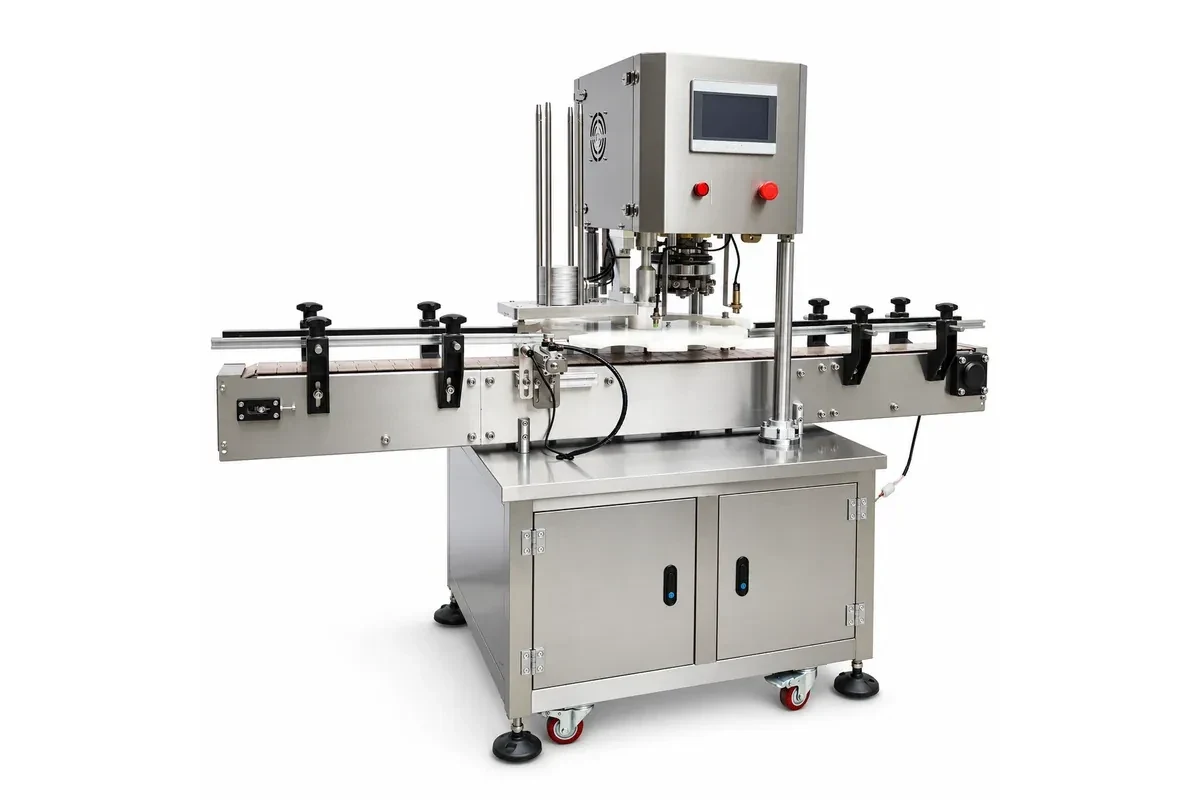
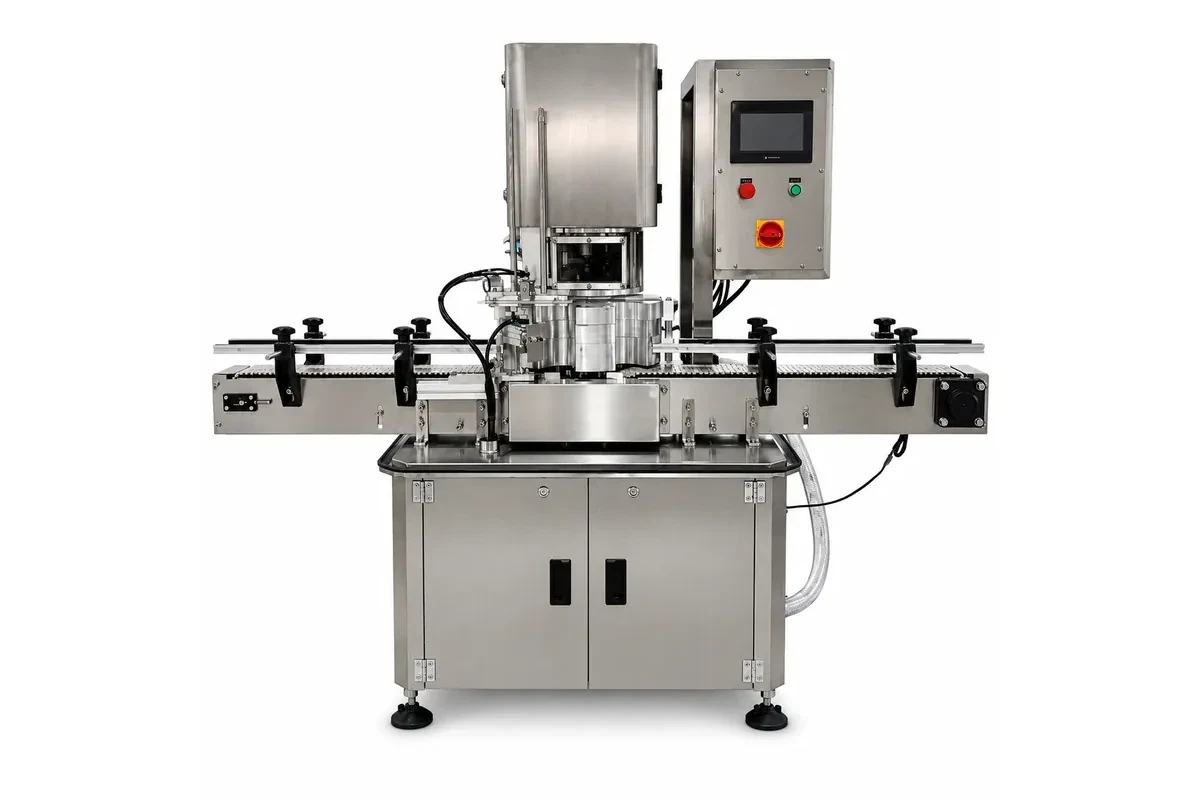
Once a conveyor-fed can filling machine precedes the closing station, our automatic servo can seamer runs at 30-45 cans/min with 1 seaming head, 1.3 kW machine power on AC 220 V, 50 Hz, >=0.4 MPa compressed air at approx. 0.3 m3/min air consumption, approx. 400 kg machine weight, and 2000 x 850 x 1700 mm machine dimensions.
On this automatic servo can seamer, the control program checks that a lid is in place: without one, the can is not seamed and the alarm sounds, while a can jam stops the machine and a one-button reset restarts it after the fault is cleared.
In a line, the seamer only needs to keep up with the filler before it: at 35 cans per minute, an 8-hour shift closes 16,800 cans before stops.
For conveyor-fed vacuum closing, our automatic vacuum can seamer runs at 25-35 cans/min with 1 seaming head using the double seam method, approx. 7 kW total power on AC 380 V, 50 Hz, >=0.4 MPa compressed air at approx. 0.3 m3/min, a 100-200 L vacuum buffer tank, approx. 650 kg machine weight, 2000 x 1000 x 1750 mm machine dimensions, and 304 stainless steel frame and doors.
When dry powders or oxygen-sensitive products require chamber evacuation followed by inert gas backfill, our automatic vacuum nitrogen can seamer operates at 4-8 cans/min with residual oxygen <3% across 1 seaming station for 73-127 mm can diameter and 50-200 mm can height, using 3 kW machine power (AC 220 V, single-phase, 50 Hz), 0.6-0.8 MPa compressed air at 0.3 m3/min, 700 kg machine weight, 2000 x 850 x 1800 mm machine dimensions, a 040 rotary vane vacuum pump, and a 304 stainless steel exterior.
Because each can is evacuated and filled with nitrogen before it is seamed, at 6 cans per minute an 8-hour shift closes 2,880 cans before stops, whereas conveyor-fed vacuum seaming without nitrogen on our LV-135ZFG covers 25-35 cans per minute.
When inline automatic seamers for plastic, paper, tin, and aluminum round cans scale from one head to two heads, the single-head VTOPS-S130G (identification number FGJ130G, 1 sealing head) runs at 25-50 Cans/min for 35-130mm sealing diameter and 50-200mm sealing height, whereas the double-head VTOPS-S130G2 (identification number FGJ130G2, 2 sealing heads) runs at 80-100 Cans/min for 40-99mm sealing diameter and 60-220mm sealing height.
On high-speed rotary beverage lines, the Angelus Legacy Series seamer seams cans between 200 - 303 (50.8- 81.0 mm) in diameter and 110 -800 (41.3-203.2 mm) high for Atmos & CM or 113 - 800 (46- 203.2 mm) high for UCG & SV, with a transfer chain pitch of 3.75 or 4" (95.3 or 101.6 mm), a 0.5 Rev/Can filler drive, and 24 VDC electrical controls.
That high-speed rotary seamer specifies 3 psi (0.2 bar) dry air at the base and upper turret housing, 125 psi @ 70F (8.6 bar @ 21C) gas supply pressure, 160F @ 70 psi (71C @ 4.8 bar) CIP hot water, 330F @ 80 psi (165C @ 5.5 bar) CIP steam, approximately 14,400 lbs (6532 kg) net weight, and approximately 16,500 lbs (7484 kg) gross weight.
Coordinate Conveyor Infeed and Servo Indexing
LINEVO Five-Configuration Can Seaming Machine Comparison
Use this matrix to match loading mode, chamber atmosphere, operating speed, can dimensions, and utility drops across our five LINEVO can seaming configurations.
| Configuration | Loading and Stations | Seaming Atmosphere | Operating Speed | Can Diameter and Height | Power, Air, and Hardware |
|---|---|---|---|---|---|
| LV-135C semi-automatic can seamer | By hand, one station | Air | 15-20 cans/min, depending on the operator | 50-126 mm diameter, 50-200 mm high | 0.37 kW, AC 220 V single-phase 50 Hz, approx. 110 kg, approx. 630 x 420 x 1350 mm, Cr12 seaming rollers |
| LV-135B semi-automatic vacuum can seamer | By hand, one station | Vacuum down to -0.060 MPa | 4-8 cans/min, depending on the vacuum | 50-130 mm diameter, 32-185 mm high | >=0.4 MPa |
| Automatic Servo Can Seamer | Conveyor-fed, 1 seaming head | Air | 30-45 cans/min | Set to customer can samples | 1.3 kW, AC 220 V 50 Hz, >=0.4 MPa air (approx. 0.3 m3/min), approx. 400 kg, 2000 x 850 x 1700 mm |
| Automatic Vacuum Can Seamer | Conveyor-fed, 1 seaming head | Double seam under vacuum | 25-35 cans/min | Set to customer can samples | Approx. 7 kW, AC 380 V 50 Hz, >=0.4 MPa air (approx. 0.3 m3/min), 100-200 L vacuum buffer tank, approx. 650 kg, 2000 x 1000 x 1750 mm, 304 stainless steel |
| Automatic Vacuum Nitrogen Can Seamer | Conveyor-fed, 1 seaming station | Vacuum + nitrogen flush (residual oxygen <3%) | 4-8 cans/min | 73-127 mm diameter, 50-200 mm height | 3 kW, AC 220 V single-phase 50 Hz, 0.6-0.8 MPa air (0.3 m3/min), 040 rotary vane vacuum pump, 700 kg, 2000 x 850 x 1800 mm, 304 stainless steel |
LINEVO five-configuration can seaming machine matrix by loading mode, atmosphere, speed, format range, and utility requirements.
Liquid Nitrogen Dosing and Headspace Oxygen Control Before Seaming
On open-top liquid can filling lines running juices, teas, or flax seed oil, a liquid nitrogen doser mounted immediately before capping or seaming pressurizes packaging for package rigidity and oxygen reduction.
Liquid nitrogen has a boiling temperature of -320°F (-196°C), and will rapidly boil away when exposed to room temperatures, so insulated equipment must be used to ensure efficiency and safety.
Documented extended shelf life studies show a 90-95% reduction in headspace oxygen content and a 59% reduction in total package oxygen when compared to a traditional gaseous nitrogen purge of headspace.
A Chart CryoDoser FleX system with a Siemens controller operates at 0.2 - 0.49 psi (0.014 - 0.03 bar) head pressure across two discrete dosing models: 750 cpm (45,000 cph) with 5 - 1000 ms duration in 1 ms intervals, and 2000+ cpm (120,000+ cph) with 1 - 1000 ms duration in 0.1 ms intervals.
A Vacuum Barrier NITRODOSE G3 Servodoser equipped with an Allen Bradley controller precisely delivers low-pressure liquid nitrogen at 2000 BPM with adjustable flow rate during discrete and continuous dosing without a nozzle change, a minimum dose duration of 5ms, and accuracy to ± 1% dose weight.
Travel time from the doser to the seamer or capper should be minimized to prevent excess boiling or loss of nitrogen, and shaking or bouncing containers on the conveyors can force nitrogen and product out of the package before closure.
Compare Open-Air Dosing Transfers Against Enclosed Chamber Vacuum Seaming
Double-Seam Mechanics, Roll Profiles, and Container Inspection Intervals
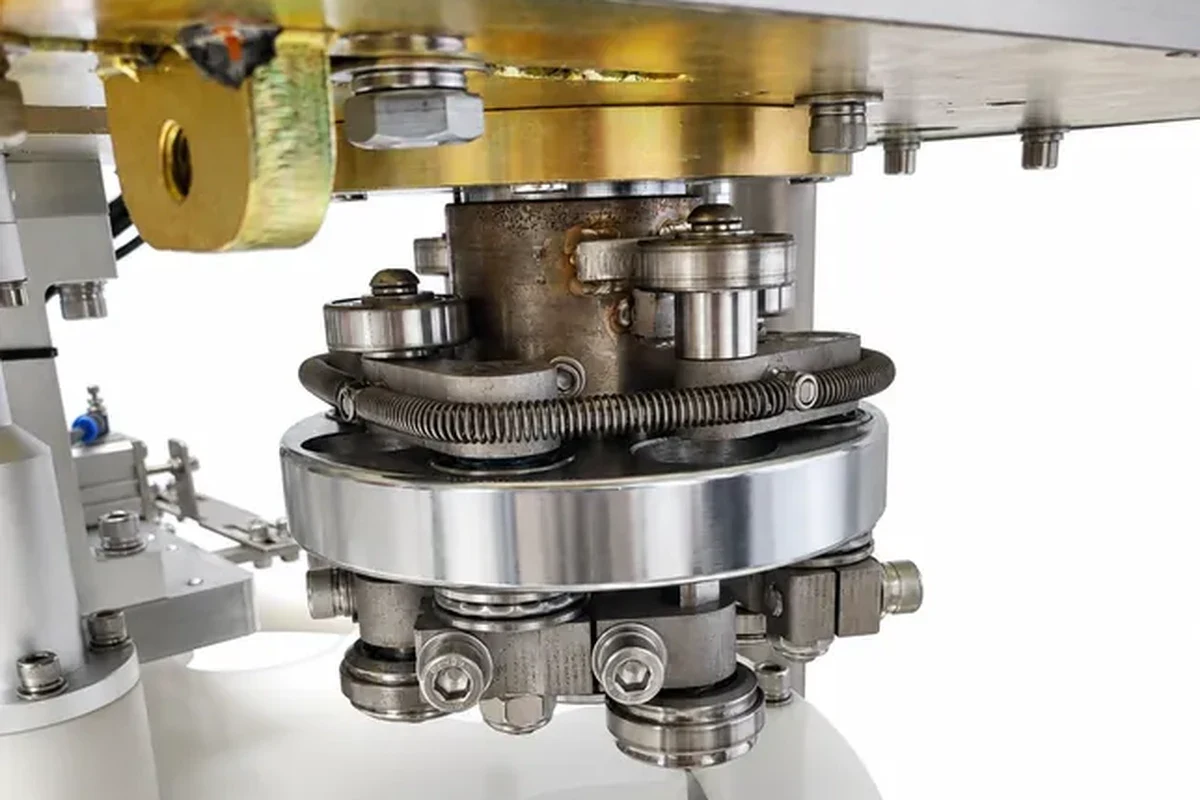
A hermetic double seam depends on two sequential roll profiles that interlock the end curl under the body flange then compress the seam with sealing compound.
Palmer Beverage Systems' single-head seamer design is cam-actuated double 1st and 2nd operation rolls with a stainless steel gearbox and drive components.
In the second operation, a second seaming roll, with a flatter, tighter profile, applies pressure to compress and tighten the partially formed seam: the five layers of metal (two from the body flange, three from the end curl; additional layers are present at the side seam junction) are pressed tightly together, with sealing compound.
A reverse wrinkle is a non-tightness type of wrinkle that projects towards the can body wall or the center of the can, is formed in the first operation seam, and cannot be ironed out regardless of the tightness of the second operation seam.
For double-seam cans, each can should be examined for cutover or sharpness, skidding or deadheading, false seam, droop at the crossover or lap, and condition of inside of countersink wall for evidence of broken chuck at intervals not to exceed 30 minutes.
Teardown examinations for double-seam cans shall be performed by a qualified individual and the results therefrom shall be recorded at intervals of sufficient frequency on enough containers from each seaming station to ensure maintenance of seam integrity at intervals not to exceed 4 hours.
Under the micrometer measurement system, cover hook, body hook, width (length, height), tightness (observation for wrinkle), and thickness are required, while overlap (by calculation) and countersink are optional; under a seam scope or projector, body hook, overlap, tightness (observation for wrinkle), and thickness by micrometer are required, while width (length, height), cover hook, and countersink are optional.
Two measurements at different locations, excluding the side seam, shall be made for each double seam characteristic if a seam scope or seam projector is used, and when a micrometer is used, three measurements shall be made at points approximately 120° apart, excluding the side seam.
Inspect First-Operation and Second-Operation Seaming Roll Alignment
Double-Seam Micrometer vs Seam Scope Inspection Requirements
Verify double-seam integrity across every seaming head using the required parameters, measurement locations, and inspection intervals below.
| Measurement System | Required Seam Characteristics | Optional Seam Characteristics | Measurement Points per Can | Visual and Teardown Intervals |
|---|---|---|---|---|
| Micrometer measurement system | Cover hook, body hook, seam width (length/height), tightness (wrinkle rating), and thickness | Calculated overlap and countersink depth | 3 points ~120° apart per can (excluding the side seam) | Visual defect check <=30 min; destructive teardown <=4 hours per station |
| Seam scope or optical projector | Body hook, optical overlap, tightness (wrinkle rating), and micrometer thickness | Seam width (length/height), cover hook, and countersink depth | 2 distinct locations per can (excluding the side seam) | Visual defect check <=30 min; destructive teardown <=4 hours per station |
Double-seam inspection parameters and measurement locations comparing the micrometer system against the seam scope or projector system.
Can Labeling Machine Integration: Condensate Removal, Pitch Math, and Accumulation
If your product is going to be labeled after being filled, consider the implications of spillage or condensate, which might form on cold products, and in the case of condensation, air knives may be required to dry the bottles before labeling.
Avery Dennison's Z3338 Adhesive Technical Overview, sections 5-6, recommends air knives close to initial label contact and effective wipe-down for that cold/wet adhesive application because excess water can cause sliding.
Steam tunnels operate at lower temperatures (180-200ºF) than dry heat shrink tunnels (200º-600ºF) and are used with containers under pressure, such as aerosols.
Conveyor interface engineering between the seamer discharge and the can labeling machine follows the same single-file kinematic relationships detailed in our bottle labeling equipment line interface guide and filling line layout planning guide.
For steady single-file flow without slip, center pitch p = v / q, where conveyor speed v is in m/min and arrival rate q is in bottles/min, and clear gap g = p - d, where d is the bottle dimension along travel in metres.
For constant arrivals, buffer positions = incoming bottles/min x interruption seconds / 60, and when the supported downstream rate exceeds continuing arrivals, recovery minutes = queued bottles / (downstream bottles/min - incoming bottles/min).
Align Single-File Conveyor Pitch and Wipe-Down Ahead of the Can Labeling Machine
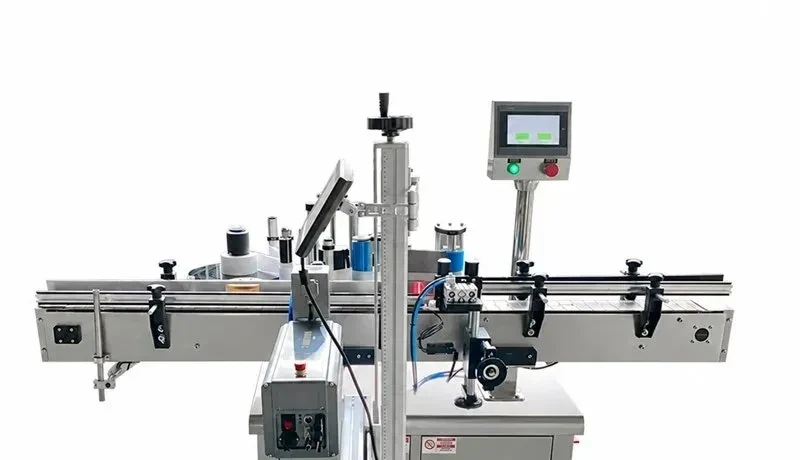
Pre-RFQ Engineering Checklist for a Can Filling, Seaming, and Labeling Line
Gather these container, product, atmosphere, and layout parameters before requesting a line configuration drawing.
- Can body material (tinplate, aluminium, or composite), empty can diameter, can height, and lid end specification.
- Product fill temperature, viscosity, carbonation level, and whether filling is open-air atmospheric or counter-pressure isobaric.
- Target headspace oxygen ceiling and closure atmosphere selection (atmospheric air, chamber vacuum, vacuum + nitrogen flush, or open-air liquid nitrogen dosing).
- Target shift output and continuous line speed matching filler head count to seamer head count and downstream labeler sprint rate.
- Surface drying air-knife placement and wrap-around pressure-sensitive vs steam-tunnel shrink sleeve can labeling machine format.
- Complete all container, utility, and layout inputs using our filling line RFQ checklist before requesting a line layout proposal.
Sources
- LINEVO PACK: Can Seaming Machines Family Overview and Individual Seamer Specifications
- LINEVO PACK: Carbonated Soft Drink Isobaric Filling and Labeling Line Configuration Scope
- Our LINEVO Engineering Library: Bottle Labeling Equipment Line Interface and Conveyor Pitch Reference
- Electronic Code of Federal Regulations: Thermally Processed Low-Acid Foods Packaged in Hermetically Sealed Containers
- Peco InspX: Can Seam Defects and Double Seam Inspection Reference
- OneVision Corporation: Can Seam Inspection Knowledge Center
- BW Packaging and Pneumatic Scale Angelus: Craft Beverage Canning Systems and Rotary Seamer Specifications
- Vacuum Barrier Corporation: Liquid Nitrogen Dosing Technical Guide and NITRODOSE Equipment Specifications
- Chart Industries: Liquid Nitrogen Dosing Systems Technical Brochure
- PDC Europe: Shrink Sleeving Machinery and Steam Tunnel Technical Guide
- Palmer Beverage Systems: In-Line Can Filling and Seaming Systems
- Alps Machine: Isobaric Can Filling Machine Process Reference
- NFE Craft Canning Systems: Beer Source and Utility Specification
- Zhengzhou Vtops Machinery: Inline Automatic Can Seaming Machine Specifications
Frequently Asked Questions
- 01How do we choose between an atmospheric servo can seamer and a vacuum or nitrogen-flushed can seamer?
- Match the seamer chamber to product oxygen sensitivity and required shift throughput. Our conveyor-fed automatic servo can seamer closes cans in ambient air at 30-45 cans/min (~16,800 cans per 8-hour shift at 35 cpm). When headspace air must be removed without inert gas, our LV-135ZFG automatic vacuum can seamer runs at 25-35 cans/min, whereas dry powders and oxygen-sensitive products requiring <3% residual oxygen use our automatic vacuum-nitrogen seamer at 4-8 cans/min (~2,880 cans per 8-hour shift at 6 cpm).
- 02When is open-air liquid nitrogen dosing used instead of a chamber vacuum nitrogen seamer?
- Chamber vacuum-nitrogen seamers evacuate and backfill individual rigid cans (such as dry milk or nutrition powders) inside a sealed station at 4-8 cans/min. For continuous liquid beverage lines running up to 750-2,000+ cpm, open-air cryogenic liquid nitrogen dosers (such as Chart CryoDoser FleX or Vacuum Barrier NITRODOSE G3 at -320°F / -196°C) inject a precise micro-drop immediately before lid placement to add thin-wall can rigidity and cut headspace oxygen by 90-95% (and total package oxygen by 59% vs gaseous purge).
- 03How often should double seams be inspected during a production shift?
- Operators must perform visual external seam checks - inspecting for cutover, sharpness, skidding/deadheading, false seams, crossover droop, and inner countersink chuck damage - at intervals no greater than 30 minutes. In addition, a qualified technician must perform and log destructive double-seam teardowns (measuring body hook, cover hook/overlap, seam width, thickness, and wrinkle tightness by micrometer at 3 points 120° apart or seam scope at 2 points) from every seaming head at intervals not exceeding 4 hours.
- 04Why do cold-filled cans need air knives before the can labeling machine?
- Chilled cans condense ambient moisture onto the aluminum wall as soon as they leave the seamer, and residual water film causes pressure-sensitive labels to hydroplane or skew during wrap-around application. Positioning high-velocity air knives immediately upstream of initial label contact strips condensate so cold/wet adhesives (such as Avery Dennison Z3338) bond cleanly under the wipe-down belt.
[Request]
Send Your Can Dimensions, Product Type, and Target Line Speed
Share your can diameter and height, lid format, liquid or powder product characteristics, headspace oxygen requirement, and shift output target on WhatsApp so our engineering team can configure the matching can filling machine, seamer, and can labeling machine.
Our team reviews your product, container and line requirements with you.
[Keep planning]
- Liquid Filling LinesFoam, drip or a narrow bottle opening can make the wrong filler a poor fit. Start with liquid behavior and container dimensions, then match the filling and downstream stations.
- Line LayoutPlan filling line space around product movement, machine interfaces, operation and service access. The final layout should connect the selected equipment with actual site dimensions, utilities and the move-in route.
- RFQ ChecklistPrepare a filling line RFQ with the product, container and closure, required accepted output, site layout and delivery scope. A shared brief lets engineering define each station and its interfaces on the same basis.
- Capping Machine IntegrationPoor cap engagement wastes filled bottles. Match an automatic capping machine to the closure, bottle restraint and cap feed, then define torque checks and line interfaces before comparing output.
- Bottle Labeling Line InterfaceHand loading a bottle labeler can add downtime to a continuous filling line. Match your bottle labeling machine to bottle holding, label format and conveyor interfaces before comparing speed.
- Bottle Format ChecksPrepare the body, neck and closure drawings, then use the format-confirmation sheet to review positioning, settings and change parts across the proposed line.