Why Glass Wine and Spirits Bottling Lines Demand Dedicated Architecture

In our bottling line configurations on our liquid filling lines hub, we build every line to order with filling, capping, and labeling stations included as configured, container feeding/unscrambling and coding/inspection optional, wetted materials/seals and case packing/palletizing to be assessed, bulk storage/blending excluded, and power, compressed air, drains, and floor supplied by the customer.

As part of our Dession group factory in Foshan, Guangdong, China, we specify that a complete-line quotation must define transfer heights, directions, product orientation, inter-machine signals (run, stop, full, empty, reject), and utilities (power, compressed air, and any vacuum or nitrogen supply for each unit), with the line balanced around the slowest unit.

When you review complete liquid filling lines or compare semi-automatic bottle filling lines, defining these mechanical, gas-management, and closure boundaries early prevents rework during factory acceptance.

Glass Container Geometry and Breakage-Free Infeed Kinematics

Every glass bottling project starts with the container finish drawing and body profile, whether Bordeaux cylindrical, Burgundy sloped-shoulder, tall Hock, or heavy-base spirits decanters.

On a glass bottle neck-finish drawing, dimension I is the inner diameter of the bottle neck (which must allow sufficient clearance for filling tubes), T is the outside diameter of the thread, E is the outside diameter of the neck, H is the height of the neck finish, and S is measured from the top of the finish to the top edge of the first thread.

Reviewing these drawing callouts alongside our container format checks guide ensures that diving or fixed vent tubes clear the neck bore per the agreed filling-tube outline.

A choke-fed bottle infeed operates with a continuous backlogged queue entering the infeed screw or indexing gate, whereas a random-fed system accepts containers arriving with variable spacing and synchronizes them gently into the pocket pitch via the infeed timing screw into the star wheel and neck guides.

Timing-screw discharge pitch is the center-to-center spacing of containers leaving the timing screw; conveyor speed must be synchronized to the timing-screw discharge pitch because running the conveyor faster than the screw discharge velocity pulls containers out of the screw pocket prematurely, causing tipping, scuffing, unstable spacing, and splashing on open-neck fills.

For steady single-file bottle flow without slip, center pitch is p = v / q (where conveyor speed v is in m/min and arrival rate q is in bottles/min, giving p in metres per bottle position) and clear gap between consecutive bottles is g = p − d (where d is the bottle dimension along travel in metres).

For constant bottle arrivals, required accumulation buffer positions equal incoming bottles/min × interruption seconds / 60, and when supported downstream rate exceeds continuing arrivals, queue recovery time in minutes equals queued bottles / (downstream bottles/min − incoming bottles/min).

On the JPACKS JAC-40F rotary-indexed ROPP capper, maximum bottle diameter is 4.25 in with a 12 pocket star wheel and 8.00 in with a 6 pocket star wheel, protected by jamming clutches with an electric signal for shutdown on product jamming and tool-less star-wheel changeovers.

The IC Filling Systems Flexiblock linear rinser-filler-capper-capsuler-labeller monoblock for craft spirits handles glass bottles from 50ml to 2000ml at speeds from 400 bph to 1500 bph (up to 1,500 bph), completing bottle size changeovers in 15-30 minutes by simple adjustments without replacing bottle handling change parts.

Rotary Starwheel Pockets and Glass Guide Rails

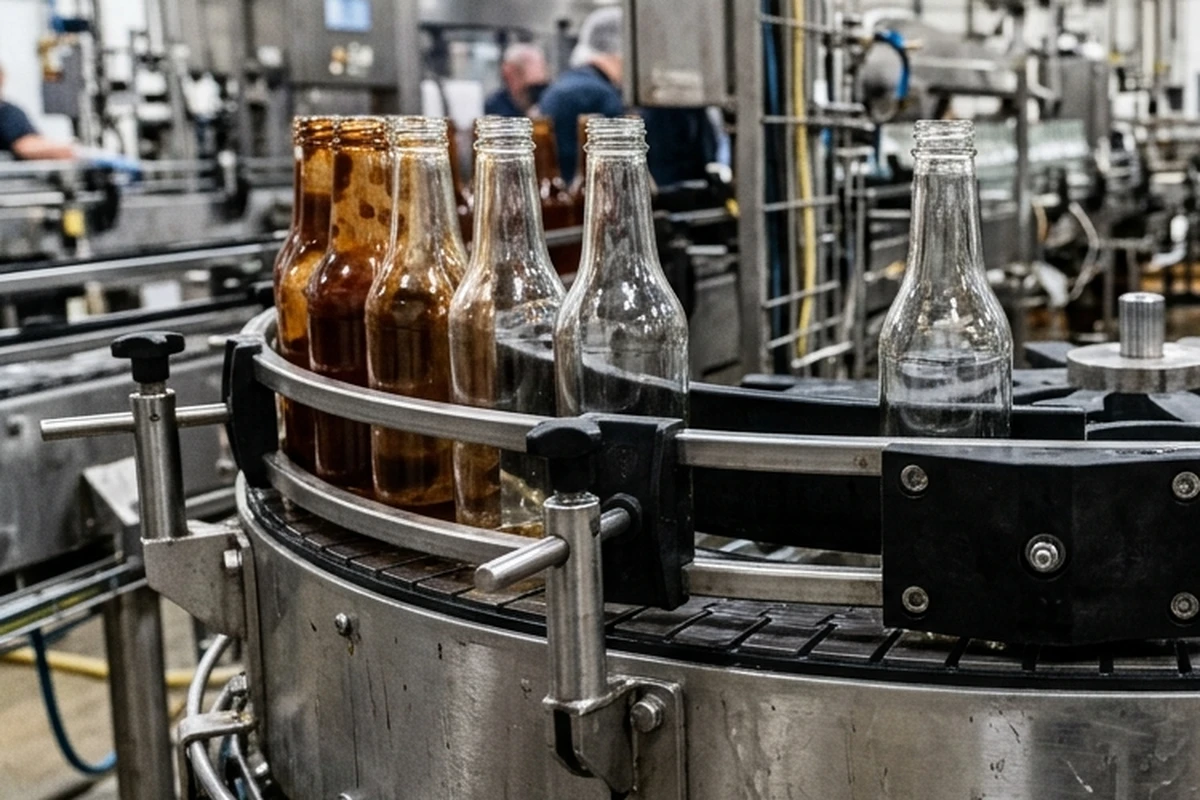
Glass wine and spirits bottles guided through a bottling conveyor with curved stainless steel guide rails
Adjustable stainless guide rails support glass bottles by the body during transfer along the conveyor.

Oxygen Pickup Benchmarks and Inert-Gas Purging Protocols

For still and sparkling wines, oxygen management across the filler and closer determines shelf life, aroma retention, and sulfur dioxide stability.

The two major contributors to oxygen in a bottle of wine at packaging are dissolved oxygen (DO) and headspace oxygen (HSO), whose sum immediately after packaging is quantified as total package oxygen (TPO), while additional oxygen enters from oxygen encapsulated in the closure and diffusing through the closure during ageing.

During wine bottling, increases in dissolved oxygen (DO) are minimised by sparging empty bottles on the filler with an inert gas and maintaining an inert gas cover on the filler tank using nitrogen, argon, or carbon dioxide (in the form of dry ice) to keep DO below 0.5 mg/L as recommended by Australian Grape & Wine's Packaging Guidelines.

AWRI total package oxygen (TPO) specifications classify <1.5 mg/L as Best practice, 1.5-2.5 mg/L as Acceptable, >3 mg/L as Requires improvement, and >4 mg/L as Poor practice.

AWRI oxygen management audits show that typically more than 60% of the oxygen in a bottled wine resides in the headspace, and most modern bottling lines achieve ~60 – 80% displacement of headspace oxygen through vacuum or inert gas application (nitrogen or argon sparging), liquid nitrogen droplets, and inert gas coverage during filling.

Headspace oxygen and oxygen encapsulated in the closure are the main sources of oxygen for bottled wines during the first 2-4 months after packaging, indirectly causing loss of free sulfur dioxide (SO2), while caution is also required with screw caps because oxygen in the internal cap cavity transfers into the headspace if the cap cavity is not sparged.

Referenced at IUPAC Standard Temperature and Pressure (STP: 273.15 K / 0 °C / 32 °F and 100 kPa / 14.504 PSI / 0.986 atm / 1 bar), nitrogen (N2, nearly 80% of the atmosphere by volume) has a gas density of 1.25 g/L (close to air at 1.29 g/L), whereas argon (Ar, about 0.9% atmospheric abundance) has a density of 1.78 g/L and carbon dioxide (CO2) has a density of 1.98 g/L.

According to Zoecklein, flushing an empty container with inert gas to reduce oxygen from atmospheric levels of about 20% to less than 1% requires about 3.25 (three and one-quarter) volume changes in the flushed vessel (for example, 200 x 3.25 = 650 L of inert gas for an empty 200 L / 52 gal vessel).

Unlike nitrogen or argon, which quickly bubble out of solution, carbon dioxide dissolves in water or wine to form carbonic acid (CO2 + H2O -> H+ + HCO3-) and can reintroduce an undesirably high level of dissolved CO2 in still wines; mixed 'beer gas' blends range from 50/50 to 75/25 N2 to CO2, and high-pressure argon/nitrogen/beer-gas cylinders use a CGA #580 regulator fitting whereas liquid CO2 cylinders use a non-interchangeable CGA #320 fitting.

AWRI's typical pre-bottling wine analysis targets specify dissolved oxygen <1.0 mg/L for white table wine, dissolved carbon dioxide of 0.8-1.2 g/L for white table wine and <0.5 g/L for red table wine (<0.7 g/L for cask wine), free SO2 of 28-32 mg/L for white and red table wines, and turbidity <1.0 NTU across table and cask wines.

For export to Ontario (LCBO, cited by AWRI), maximum turbidity for filtered wine is 5 NTU for white wine, 8 NTU for rosé wine, and 10 NTU for red wine.

During bottling, AWRI notes that the first bottles off the line are measured for set-up conformance and gas uptake, followed by a representative post-bottling sample often taken after about 30 minutes (½ hour) into the run.

Fill-to-Level Valve Technologies, Ullage Geometry and Spirits Safety

For a broader comparison across liquid viscosities, see our guide on how to choose a filling line.

In a vacuum wine bottle filler, a vacuum pump creates a low-pressure environment inside the bottle so atmospheric pressure draws wine from the supply line until the liquid reaches the tip of the filling nozzle, breaking the vacuum and stopping flow with virtually no drips or spills; in an overflow filler, wine flows until reaching the nozzle overflow port and excess siphons back to the main tank for an identical liquid level in every bottle.

Vacuum fillers require rigid containers such as glass or hard plastic that maintain structural integrity under vacuum and deliver high fill-level consistency for low-viscosity, free-flowing liquids (wine, spirits, oils, vinegars, perfumes) with reduced foaming and dripping, whereas volumetric piston fillers use a piston-cylinder stroke for high volumetric precision on thick or particulate liquids.

JPACKS wine bottle filling machine selection specifications cite liquid level control accuracy of ±1mm or better, food-grade 304 or 316 stainless steel wetted construction, adjustable bottle compatibility such as 170-340mm height and 50-100mm diameter, and filling speeds ranging from 100-200 BPH on manual tabletop fillers to 6,000-12,000 BPH on automated rotary fillers.

For vacuum wine bottle fillers by head count, a single-head Enolmatic unit fills approximately 180 bottles per hour and draws wine from vessels up to 4 meters (13 feet) below the filler; a 4-head Enolmaster semi-automatic vacuum filler fills approximately 600 bottles per hour for bottle heights of 180-350mm; and fully automatic systems with 12 or more filling heads process 1,500-3,000 bottles per hour or more.

Accutek's AccuVac Series semi-automatic vacuum level fillers fill small volumes from 2 ml to 6 oz of low-viscosity liquids up to 800 cps at speeds up to 35 containers per minute using diving no-drip nozzles and all-pneumatic components that require no electricity for safe use with flammable or sensitive products.

Accutek's analog Siphon Filler stops flow automatically when liquid levels in the 7.5-gallon hopper with float-controlled valve and the bottle reach equilibrium, regulating bottle fill level via the bottle holder rack height, with fill amount 4 oz to 2.5 gal for containers ranging from 2 ounces to 1 gallon (and potentially up to 2 gallons), bottle heights from 4” to 15”, minimum bottle opening of ½”, and speeds from 3 to 30 containers per minute on a five-spout machine.

For conventional glass wine bottles under cylindrical cork, fill height (top of bottle to wine surface) is generally between 55 and 63 mm (with >49 mm corks requiring greater distance) and headspace is 0.1 to 1.0% of total capacity; Australian guidelines specify ullage distance >12 mm at 20°C for standard CE.T.I.E cork mouth bottles and at least 13 mm at 20°C for nominal 750 mL bottles per Amon & Simpson (1986).

An ideal wine filling temperature is around 18°C (wines supplied to bottling facilities outside 15-21°C may incur fees if the wine needs to be chilled or warmed); filling too cold causes bottle condensation that impairs label adhesion unless dried in a post-sealing heat tunnel, while low ullage subjected to moderate heating (~35°C) can raise bottle pressure above 50 kPa (reaching the bottom of the cork at as low as 29°C in poor combinations versus 43 to 55°C for 10-16% alcohol wines with an appropriate closure).

IC Filling Systems states that filling spirits (whisky, gin, vodka, rum, brandy) at 40% ABV strength does not require undue special attention and can use gravity fillers, whereas cask-strength spirits from 45% to over 70% ABV require ATEX rated machines for spirits of 45% ABV and above.

Level-Filling Nozzles and Neck-Sealing Collars

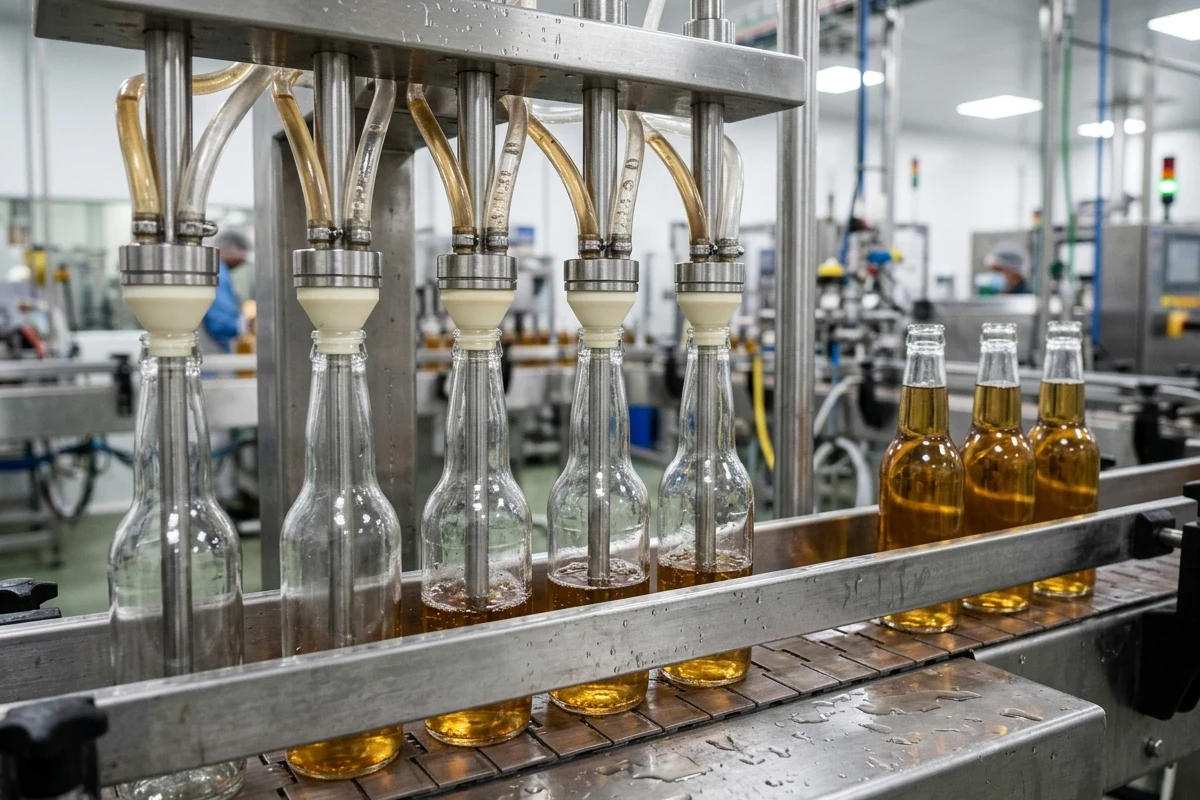
Sanitary stainless-steel vacuum level filling nozzles lowered into glass bottle necks
Sanitary stainless-steel diving nozzles filling glass bottles.

Primary Closure Engineering: Natural Cork, BVS ROPP and Bar-Top T-Corks

For traditional table wines sealed with cylindrical natural or technical corks, bottle bore profile and cork conditioning must be tightly matched.

Natural cork closures for table wines are usually 44 or 49 mm in length (varying ± 1mm) and around 24 mm in diameter (varying ±0.5 mm); standard CE.T.I.E wine glass finish bottles are designed for 44 mm length closures, whereas at 49 mm depth the bottle neck (particularly on Burgundy-shaped bottles) is more bell-shaped and wider, making seal compression more difficult.

A 44 x 24 mm natural wine cork typically carries 16-18 mg of surface coating/treatment to lubricate entry into the glass neck, has a moisture content of 6±2%, and should contain <2 mg dust per stopper to prevent sealing faults or wine contamination.

In an automatic corker, four jaws compress the cork diameter from 24 mm to about 15-16 mm before a pushing pin inserts it so the stopper neither protrudes above the rim nor is over-inserted by more than 1 mm; the cork recovers about 85% of its original diameter after a few hours, and CE.T.I.E (1980) recommends keeping filled bottles upright for a minimum of three minutes (while Amon & Simpson 1986 recommend at least five minutes and preferably one to two hours).

To prevent bottle pressure from exceeding 1 bar (100 kPa) during thermal expansion or reaching the critical leakage pressure of 200 kPa per Amon & Simpson (1986) (with Cork Supply Australia recommending <20 kPa at 20ºC), vacuum corkers extract air from the bottle neck via a vacuum pump channel during cork insertion, yielding an average headspace pressure of -5 kPa under vacuum fill compared to 15 kPa under non-vacuum normal fill.

Cylindrical cork extraction force should be measured more than one hour after sealing; McMahon (1994) and CE.T.I.E (2008) specify natural cork extraction forces of 230–400 N (McMahon) or 120–350 N (CE.T.I.E) for 38 x 24 mm corks, 250–450 N (McMahon) or 120–400 N (CE.T.I.E) for 44 x 24 mm natural corks (100–450 N for synthetic), and 270–480 N (McMahon) for 49 x 24 mm corks.

Aluminum wine screw caps (Stelvin / BVS) seal by compressing a three- or four-layer PVDC (Saran) liner disc with an expandable polyethylene backing against the glass bottle neck rim rather than the internal bore; Saran Tin liners have an oxygen transmission rate (OTR) of typically 0.00005-0.0005 cc O2/day, while Saranex liners have an OTR an order of magnitude higher at around 0.0001-0.001 cc O2/day.

During Bague Verre Stelvin (BVS) aluminum ROPP screw-cap application, a rotating sealing head pushes a plunger/pressure pad and circumferential redraw die down onto the cap rim and slightly down the side of the glass finish, producing a redraw elongation of the closure of approximately 0.5 mm (CE.T.I.E Bottling Guide No. 6 2016 / Rev 2 March 2020), while thread rollers form the closure into the bottle-finish thread profile and tuck rollers crimp the skirt under the locking bead.

Stelzer (2005) as cited by AWRI specifies recommended screw-cap removal torque ranges (the twisting force to break the tamper-evident bridges and open the cap) of 1.40 – 2.80 Nm for Auscap, 0.68 – 2.83 Nm for GlobalCap when tested 24 hours after capping (with limits increased by 10% if tested immediately after capping), and 0.90 – 1.81 Nm for Péchiney 30 mm diameter screw caps.

According to ASTM D2063/D2063M-24 Clauses 5.1, 5.2, 5.3, and 1.1, continuous-thread closure torque retention on containers with matching finishes is evaluated under controlled conditions using a non-automated spring torque-meter (dial indicator or digital readout) or torque wrench to measure removal torque for predetermined environmental conditions over time.

The JPACKS JCP-1 Automatic T Cork Placing and Pressing Machine for bar-top / T-shaped corks uses a servo-driven pick-and-place device with electrical cylinder to pick a T-cork from the chute, pre-insert it into the bottle mouth, and press it home, and separately a servo motor drives a high-precision PPU cam manipulator, accommodating bottle heights of 120mm-350mm and bottle diameters of 50mm-150mm at ~ 30 BPM with an explosion-proof electric cabinet.

The JPACKS JAC-40F Automatic Single Head ROPP Capping Machine features a 304 stainless steel welded frame, gear-driven transmission, a 24 inch vibratory cap feeder disc with polyurethane liner, and a 4.5 Cubic feet floor-level stainless hopper with an 8 inch cleated belt (6 inch spacing, 2 inch cleats), operating on 380 Volts, 50/60Hz, 10 Amps electricity and 5 CFM @ 80psi compressed air.
Primary and Secondary Closure Tooling at Backlight Inspection

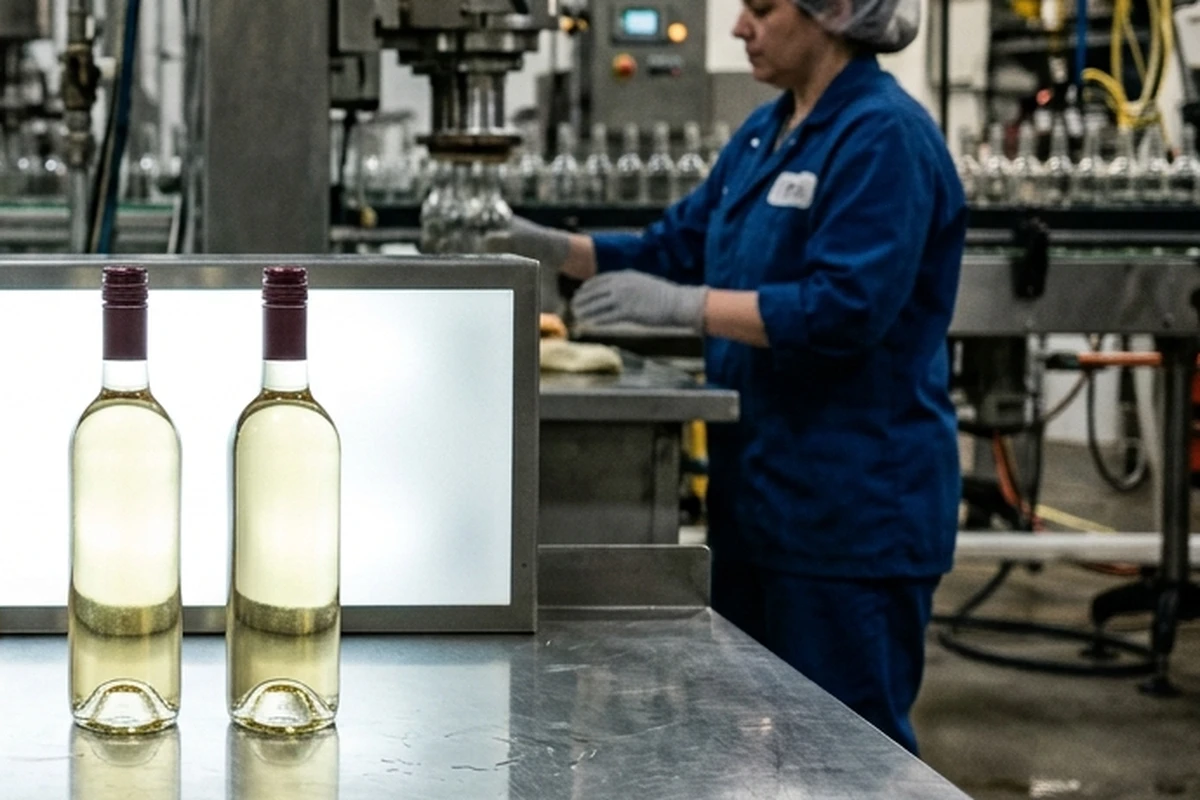
Filled glass wine bottles with aluminum screw caps at a backlight inspection station
Filled glass wine bottles with aluminum ROPP screw caps at a backlight inspection station.

Monoblock vs Inline Architecture, Secondary Packaging and Sanitation

Choosing between a synchronized rinser-filler-closer monoblock and a modular inline line depends on floor space, throughput, and how critical oxygen pickup is between filling and sealing.

The MBF Synchrofill monobloc installed at Gusbourne Estate integrates a rinser, filler, capper, corker, crown capper, and bidule and Vinoloc glass stopper inserters in a single block running at speeds up to 4,500 bottles per hour, using a patented system for minimum nitrogen consumption and speed-independent inert-gas injection into the bottle before filling.

IC Filling Systems supplies Rinser / Filler / Capper Monoblocks with throughputs from 500 to 16,000 bph (including 9-9-1, 20-20-5, 24-24-4, 24-24-6, 32-32-8, and 48-12 turret configurations) combining gravity or isobaric fillers with ROPP cappers, corkers, or T-cork applicators.

In a monoblock bottling system, bottle feeding, filling, cap placement, and capping are integrated into one compact machine with short, controlled bottle transfer and reduced conveyor length, whereas an inline bottling system links independent machines by conveyors for modular customization, individual servicing, and easier line expansion.

Downstream of the primary closer, cork-sealed wine and spirits bottles pass through capsule applicators, heat-shrink or spinning heads, and multi-station pressure-sensitive labelers, where conveyor handoffs follow the rules in our bottle labeling equipment line interface guide.

IC Filling Systems supplies secondary-sealing capsuling machines spanning 500 to 30,000 bottles/hour, including a combi unit combining 3 station labelling with a capsuling top-sealing machine operating at 2,000 bottles per hour.

Gusbourne Estate pairs a Robino & Galandrino Capsulator (which orientates and pre-pleats capsules with a cork and wirehood presence detector) with a three-station PE Labelling machine.

For secondary capsule sealing on ½ litre to 2 litre glass bottles (180 mm min to 360 mm max height) with capsules up to 60 mm max length, IC Filling Systems specifies a thermal heat-shrink head for PVC capsules with temperature regulation (220 V single-phase, 50 Hz, 1,2 Kw, 12kg) and a bench rolling head with adjustable-pressure bronze spindle for multi-R, Al, and tinfoil capsules (220/380 V, 50 Hz, 0,18 Kw, 1400 rpm or 2800 rpm on request, 28 Kg).

Wineries define bottling line sanitation as a 3 log (99.9%) decrease in cell number; a typical regime cleans with a 0.5-2% alkaline/caustic solution (pH>9) for 15-20 minutes, neutralises with a 0.6%-1% citric acid rinse for five minutes, and sterilises stainless steel lines and filler heads with hot water at 80ºC for a minimum of 30 minutes (or steam with valve condensate >80ºC for >20 minutes), while avoiding chlorine-based or scented cleaners to prevent chlorophenol and chloroanisole taints.

On a single wine bottling line, AWRI notes that dry white wines are typically filtered and packaged first, followed by off-dry white wines, dry red wines, and finally sweeter red wine styles before repeating full cleaning and sanitation; during breakdowns, surfaces are spot-sanitised with 70% w/w (80% v/v) ethanol or isopropyl alcohol, and breakdowns >4 hours require re-sanitation consideration.

Buyer RFQ Specification Worksheet for Wine and Spirits Lines

When you prepare an inquiry for a wine bottling line or spirits bottling line equipment, sharing the parameters below lets our engineering team size the rinser, level filler, closure turret, and accumulation conveyors around your glass drawings.

Specification AreaWhat to Provide in Your BriefHow It Shapes the Line Proposal
Glass bottle drawings and formatsFull container drawings showing height, body diameter, punt shape, and neck finish dimensions for every bottle formatDetermines timing-screw pocket pitch, starwheel sets, diving or fixed nozzle clearance, and guide-rail adjustments
Product chemistry and proofStill wine style, dissolved gas levels, filling temperature range, and alcohol strength for distilled spiritsSelects wetted stainless steel grade, gravity vs vacuum level-filling valves, and explosion-proof electrical classification
Oxygen pickup and inert gasTarget dissolved oxygen and total package oxygen limits, plus available nitrogen, argon, or carbon dioxide utilitiesConfigures pre-evacuation vacuum pumps, inert-gas sparging nozzles, filler-bowl gas cover, and under-closure headspace flushing
Primary and secondary closuresNatural or technical cork dimensions, aluminum screw cap finish, or bar-top T-cork geometry, plus PVC or tin capsule typeSelects vacuum corker jaw head, ROPP redraw and thread-rolling turret, servo T-cork press, and thermal or spinning capsuler
Labeling, drying and shift outputFront, back, and neck label dimensions, cold-fill condensation drying needs, and target bottles per hourSizes post-sealing drying tunnels, multi-station labelers, inter-machine accumulation buffers, and monoblock vs inline layout

Send bottle drawings, closure specifications, and target shift output together so every turret and transfer starwheel is sized as one system.

[Sources]

Common Questions

01Why do glass wine and spirits bottling lines use vacuum or gravity level fillers instead of volumetric piston fillers?
Molded glass bottles vary in wall thickness and internal capacity, so dosing a fixed volume leaves uneven liquid heights in the neck. Vacuum and overflow level fillers seal against the rigid glass mouth and stop flow or return excess liquid at the exact nozzle vent height (within ±1 mm accuracy, typically 55-63 mm fill height for corked wine bottles), ensuring uniform shelf appearance with minimal foaming or dripping.
02How do wine bottling lines keep dissolved oxygen (DO) below 0.5 mg/L during packaging?
Lines limit oxygen pickup to <0.5 mg/L (and total package oxygen <1.5 mg/L) by pre-evacuating or sparging empty bottles with nitrogen, argon, or CO2 (~3.25 volume changes to drop O2 below 1%), blanketing the filler bowl with inert gas, and flushing the headspace or screw-cap cavity immediately before closure.
03At what alcohol strength (% ABV) does spirits bottling line equipment require ATEX explosion-proof certification?
Standard bottled spirits at 40% ABV (whisky, gin, vodka, rum, brandy) can run on conventional gravity or low-vacuum fillers, whereas high-proof and cask-strength spirits at 45% ABV and above (up to 70%+ ABV) require ATEX explosion-proof electrical cabinets, motors, and sensors (or all-pneumatic drives) to prevent vapor ignition.
04How much do automatic corker jaws compress a 24 mm wine cork, and how long must bottles stay upright after corking?
Four-jaw compression heads squeeze a 24 mm diameter cork down to 15-16 mm before the plunger seats it flush (within 1 mm below the glass rim) while vacuum extraction holds headspace pressure near -5 kPa. Because the cork takes several hours to recover ~85% of its diameter, filled bottles should remain upright for at least 3-5 minutes (and preferably 1-2 hours) before inversion or case packing.
05When should a winery or distillery choose a monoblock over an inline bottling line?
Choose a synchronized rinser-filler-closer monoblock (ranging from 400-1,500 bph craft blocks up to 4,500-16,000 bph rotary turrets) when floor space is tight and immediate starwheel transfer between filling and corking/capping is needed to prevent oxygen ingress. Choose a conveyor-linked inline layout when you need modular station spacing, independent machine maintenance, or future capacity upgrades.

[Request]

Request a Wine or Spirits Bottling Line Proposal

Share your glass bottle drawings, alcohol strength, closure type, and target shift output to discuss your wine or spirits bottling line on WhatsApp.

Our team reviews your product, container and line requirements with you.