
[Buying guides]
Cosmetic Filling and Packaging: Plan Bottle Formats
Plan cosmetic bottle formats with one record per finished SKU. Product, container, closure, label and the change between SKUs determine which settings, contact parts and handling tools the line needs.
Updated October 2026
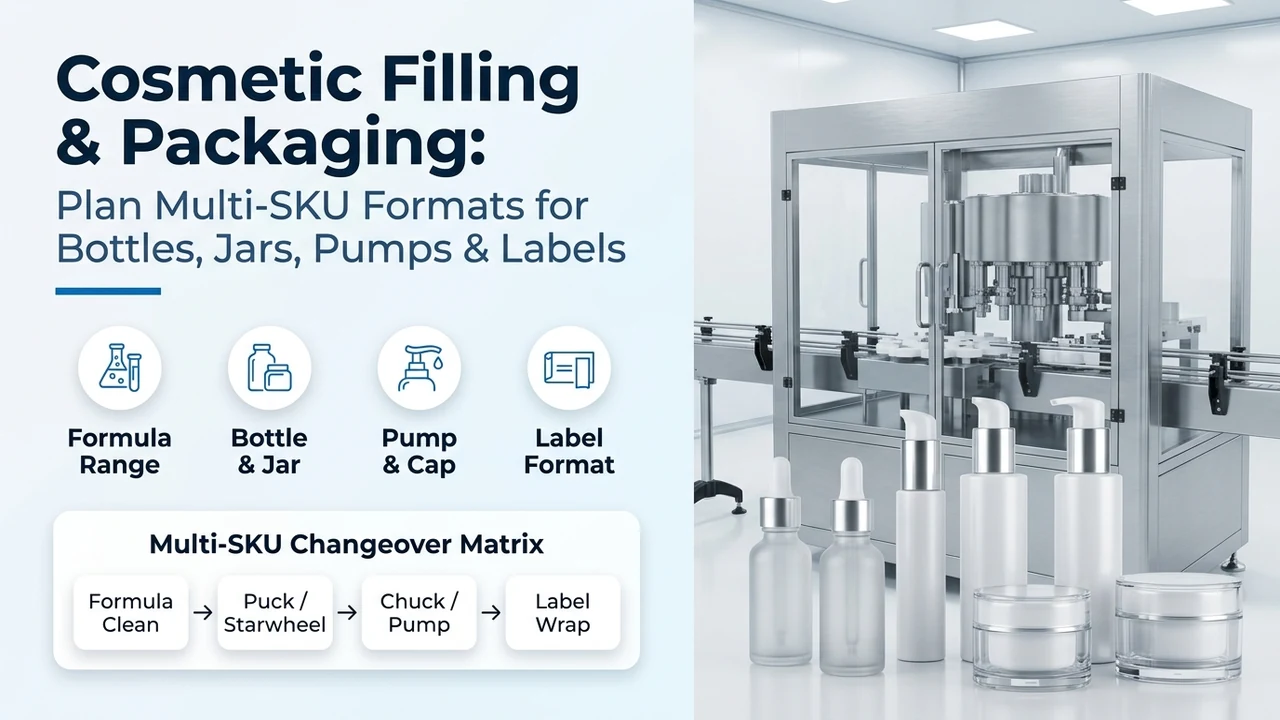
Quick View: Inputs for Each Cosmetic Pack
Scroll across to read all three columns.
| Input | Record from | Decision it supports |
|---|---|---|
| Formula and dose | Product sheet; dose in mL or g; filling temperature in °C | Product path and filling questions |
| Bottle or jar | Container drawing and neck view | Nozzle access and container handling |
| Closure | Cap or pump assembly drawing | Placement and closing tasks |
| Label | Label drawing and roll specification | Label application and alignment |
| SKU transition | List of formula and pack differences | Cleaning, settings and changed parts |
Build a Format Record Before Choosing Stations
We plan cosmetic filling and packaging around a product and its finished pack together. Give every combination its own row: the same lotion in a round bottle with a screw cap and an oval bottle with a pump represents different handling and closing questions.
The manufacturing review connects the filling, container handling, closure application and labeling stations to the same SKU matrix. Carry that matrix into format tooling, acceptance checks and operator handover.
Start with how to choose a filling line for the whole project brief. Here, the narrower decision is whether each proposed station covers every intended SKU, and what changes between them.
The SKU Matrix: One Row per Finished Pack
Copy these fields into a spreadsheet as columns, then enter one row for each finished SKU. Keep the buyer inputs separate from the supplier answers. Leave unknown dimensions, settings and parts blank; a blank must stay an open question until someone owns the answer.
| Record field | Buyer enters | Supplier confirms |
|---|---|---|
| SKU and formula | Internal SKU name; formula reference; product sheet; filling temperature in °C | Product-contact materials and filling method for that formula |
| Dose and presentation | Declared fill in mL or g; desired headspace; whether visible level matters | Dose setting and the basis for checking the filled pack |
| Bottle or jar | Drawing reference; material; height, width and depth in mm; neck drawing; photographs | How it stands, is located under the nozzle and passes to the next station |
| Closure assembly | Cap or pump drawing; thread or attachment details; dip tube; liner or inner component | Feeding, placement, tightening or pressing, and any orientation requirement |
| Label | Label dimensions in mm; wrap or front/back; application position; roll specification | Applicator arrangement, bottle alignment and any format adjustment |
| Change from previous SKU | Formula, dose, container, closure and label differences | Setting changes, removable parts, cleaning tasks and responsibility |
| Coverage decision | Your required combination, including unresolved inputs | Included / additional parts / further assessment / excluded, with a reason |
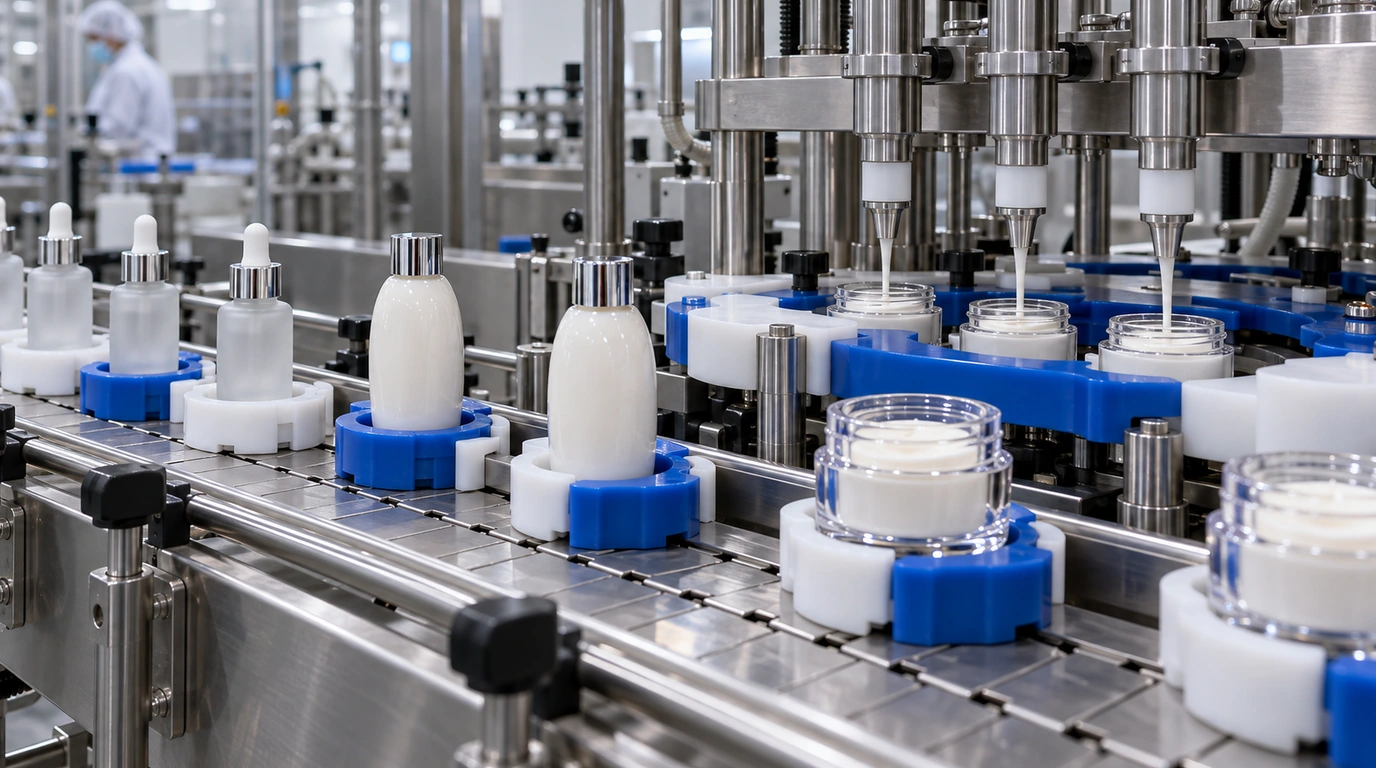
Carrier Pucks and Format Tooling
Compare the container support and contact surfaces for each cosmetic SKU. Carrier inserts and station tooling still need a format-specific record even when an outer carrier is shared.
Separate a Product Change from a Packaging Change
A formula change and a packaging change need separate checks, even when they happen during the same stop. A new formula in the same bottle prompts questions about the product path, cleaning and dose. The same formula in a new bottle prompts questions about bottle support, nozzle access, closure handling and labels.
Keep two lists: product-path tasks for cleaning, contact materials and dose checks; format tasks for guides, supports, closure tools and labeling adjustments. A stored recipe supplies settings while the part list identifies the physical tooling to exchange.
Write the Difference Between Two SKUs
Use the transition to identify the affected parts and settings. Measure the complete change from the last accepted pack of one SKU to the first accepted pack of the next.
| Transition | Product-path questions | Packaging questions |
|---|---|---|
| Same bottle, different formula | Which contact parts and seals suit the next product? What cleaning and dose checks apply? | Are the cap and label also unchanged? Record this explicitly. |
| Same formula, new bottle | Does the dose change? Is the nozzle still suitable for the opening? | Which guides or supports adjust? Does the cap or label station need other parts? |
| Same bottle, screw cap replaced by pump | Does the finished pack need a different headspace? Who confirms it? | How is the pump presented, its tube inserted and its final position controlled? |
| Formula and pack both change | List the cleaning, contact-material and dosing questions | List the container, closure and label changes independently |
Closure Placement Space
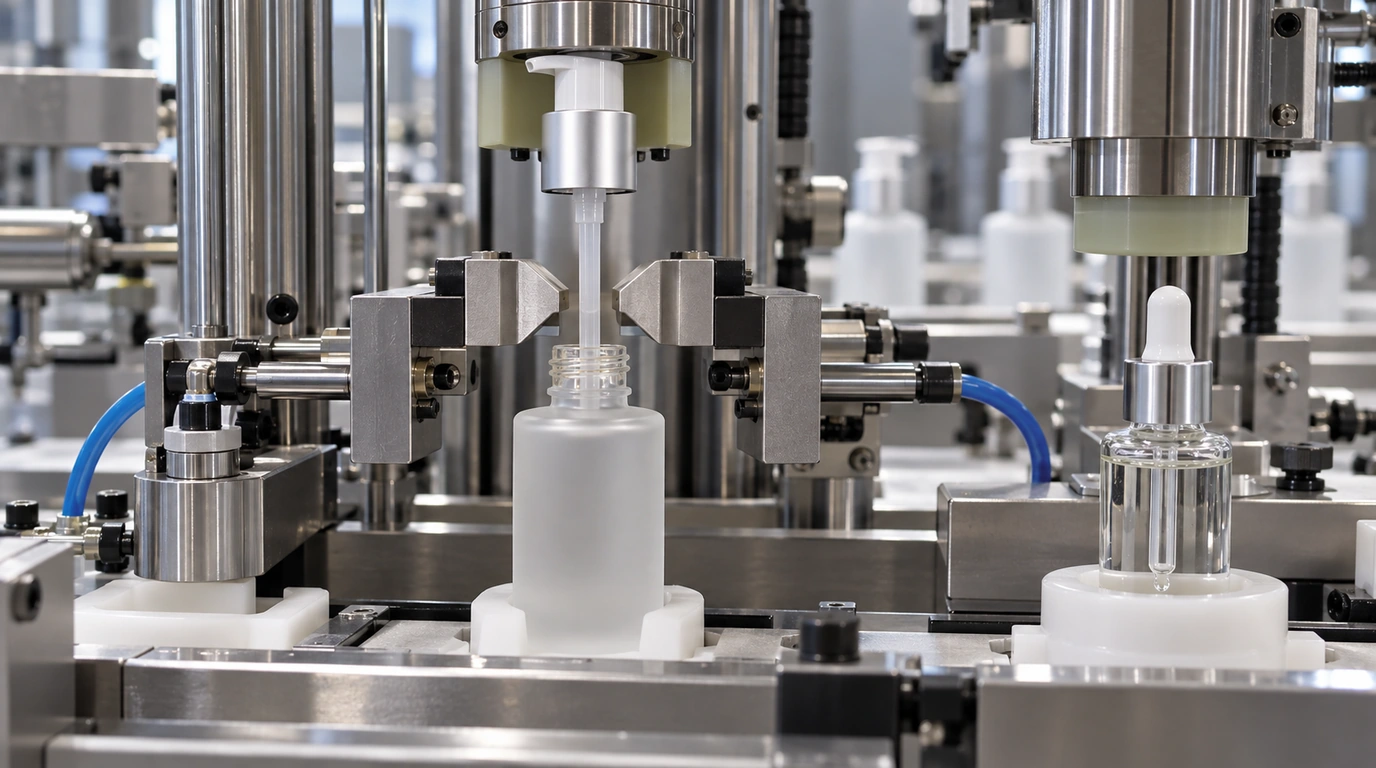
The closure review includes pump or dropper geometry, insertion path, collar grip and the finished surface. Trial the complete assembly with its actual neck and component variation.
Check the Product Path and the Bottle Opening
Record flow at filling temperature, foaming, stringing after cutoff and any particles or abrasive ingredients. Abrasive scrubs add wear considerations at the moving surfaces, valves and seals; record those contact points in the formula’s equipment review.
Ask the supplier to name the proposed metering method, nozzle and contact materials against each formula. For thinner products, the liquid filling lines page lists the starting inputs. For thick or stringing products, use the paste filling lines page to prepare the product and nozzle questions.
Then connect that answer to the actual opening. Provide the neck drawing and a view of the shoulder, rather than only the nominal bottle capacity. Ask whether the nozzle can reach its intended position and withdraw before the bottle moves. Record how bottles are supported during filling and at the handover.
Give the Closure Its Own Format Entry
Bottle capacity does not define the closure. Cetie’s public flaconnage overview describes separate neck-finish work for crimped, snap-on and screw closures. Our practical recommendation is to attach the exact bottle-neck and closure drawings to the same SKU record, including their revision references.
For a screw cap, ask how the bottle is held and how tightening is set and checked. For a pump, add the dip-tube details, how the assembly is presented to the bottle, and whether the actuator needs a defined final orientation. For a jar with a separate insert or inner lid, record that component as another placement task.
Ask which actions remain manual and which quoted station performs each automatic action. Do not assume a pump can follow the same feeding and application path as a loose screw cap. A quotation should state the closure combinations covered and any extra tooling or assessment.
Guide Adjustment During Changeover
Record the guide, tooling and label-position changes between formats, followed by the first-pack checks. Stored settings cannot replace a physical part that no longer fits the container.

Check Label Alignment as Well as Label Size
List whether each pack uses a wrap label, a front label, or front and back labels. Record the intended label position relative to a flat face, bottle feature or pump direction. Supply the bottle drawing, label dimensions and roll specification together.
Hold flat or oval bottles in the required face orientation through each application point. Guides, centering and driven belts need to match the bottle’s contact surfaces and the label positions. Check alignment relative to the same bottle feature after each format change.
Ask what adjusts when height or width changes, what parts are exchanged, and how alignment is checked after the change. A similar label width does not establish that a round-bottle wrap setup covers a flattened oval pack.
Ask for a Station-by-Station Change List
A useful answer names both the task and the affected format. “Adjustable” without a format list does not close the question.
| Station or task | Answer to request | Who completes it |
|---|---|---|
| Product feed and filling | Product-contact parts; cleaning steps; dose and nozzle settings for each SKU | Supplier, with buyer formula and cleaning requirements |
| Container handling | Guide and support settings; any exchange parts; format reference | Supplier, using buyer container drawings |
| Closure application | Feeding and placement route; cap tool; tube handling; checks after adjustment | Supplier, using buyer closure assembly details |
| Labeling | Label-roll setup; alignment settings; changed guides or applicator parts | Supplier, using buyer pack and label files |
| Release after changeover | Who checks the first filled, closed and labeled pack; what is recorded | Buyer and supplier agree the checks |
| Coverage and ownership | Every SKU marked included, additional parts, assessment or excluded; named owner for each open item | Supplier answers; buyer reviews |
Keep time estimates blank until the actual change tasks and the conditions for measuring them are agreed.
Read the Coverage Decision Before Comparing Quotes
For each SKU, look across every station rather than stopping at the filler. A covered fill volume with an unresolved pump or label entry is an incomplete answer for that finished pack. Ask for the outstanding item, the person responsible and what evidence would close it.
When the same lotion moves from a round screw-cap bottle to an oval pump bottle, compare dose, bottle support, pump placement and label alignment independently. Carry each changed task into the format-part list and acceptance checks.
Keep future formats in a separate section and ask whether they need another review. Avoid treating a broad format range as confirmation of a bottle, closure and label combination the supplier has not seen.
What to Send Us
| Item | Why we need it | Example format |
|---|---|---|
| SKU list and formula references | Keeps each product and finished pack paired | Spreadsheet using the fields above |
| Product behavior, dose and filling temperature | Defines the product-side questions | Product sheet plus mL or g and °C; unknown where undecided |
| Bottle or jar drawings and photos | Shows dimensions, opening and support surfaces | Dimensioned drawing plus neck and side views |
| Cap, pump and inner-component details | Defines each closing task | Closure drawing and assembly photos with dip tube visible |
| Label files and roll specification | Defines placement, alignment and roll setup | Label drawing and supplier roll sheet |
| Changes between SKUs and manual tasks | Identifies the changeover and supply boundary | Marked transition list with open questions |
Measure Insertion Clearance and Changeover Time
For a centered circular inserted component, radial clearance in mm = (minimum neck bore − maximum inserted-component diameter) / 2. Use the current component and neck drawings with their tolerances. Include tube bend, alignment and the insertion path in the placement check.
Record changeover from the last accepted pack of the outgoing SKU to the first accepted pack of the next. Identify cleaning, exchanged parts, setting changes and first-pack checks on a common timeline. Add sequential durations and account for overlapping tasks once; use the resulting stopped window for scheduling and cost comparison.
[Sources]
- Cosmetics filling discussion: formulation behavior, dosing and product-contact requirements. tranful.com/blogs/news/cosmetics-personal-care-filling-solutions
- Inline servo-capping configuration and closure-handling arrangement. www.jpacks.com/Product/JPPU-40-Automatic-Inline-Servo-Capping-Machine.html
- Septimatech Change Parts: bottle-handling tooling, locating features and format identification. www.septimatech.com/products-and-services/machine-changeovers/change-parts/
- Cetie, Bottling of home and personal care products and perfumes: neck finishes, flaconnage geometry and decoration considerations. www.cetie.org/en/bottling-of-home-and-personal-care-products-and-perfumes_4_107.html
Common Engineering Questions: Multi-SKU Cosmetic Bottle Format Planning, Pucks & Changeovers
- 01When should cosmetic bottles use carrier pucks?
- Assess pucks where container shape, stability, surface finish or orientation makes direct handling difficult. Compare the actual pack range and change parts; a shared outer carrier alone does not remove every format adjustment.
- 02How are pump tubes and droppers inserted?
- Review the neck bore, complete closure geometry, component variation and motion path. Define the support, alignment and placement tooling with representative samples.
- 03How is a product change different from a format change?
- A product change concerns supply, contact materials, cleaning and dosing. A format change concerns container support, closure and label handling. Record both lists when formula and packaging change together.
- 04How can capping avoid marking cosmetic closures?
- Review the grip surface, liner, applied force and tightening method against the actual closure. Check the finished appearance and closing result in the trial, including any pump actuator or dropper components.
- 05Can one line cover toner, serum and cream?
- Assess each formulation and dose with its container. The format matrix should name the metering and contact parts, cleaning work and handling changes required for every proposed combination.
[Request]
Discuss Your SKU and Format List
Use the SKU matrix and transition list for the cosmetic format discussion, with each finished pack tied to its drawing revisions.
Our team reviews your product, container and line requirements with you.
[Keep planning]
- Liquid Filling LinesFoam, drip or a narrow bottle opening can make the wrong filler a poor fit. Start with liquid behavior and container dimensions, then match the filling and downstream stations.
- Paste Filling LinesAir and stringing in a paste end up as short fills and dirty seals. Tell us how your product behaves at filling temperature and we configure the feed, dosing and sealing around it.
- ShampooFoam in the neck can cause short fills and a messy bottle. Define the shampoo’s filling condition, bottle opening and closure before selecting filling and capping stations.
- Line LayoutPlan filling line space around product movement, machine interfaces, operation and service access. The final layout should connect the selected equipment with actual site dimensions, utilities and the move-in route.
- Filling Line CostCompare filling line prices after matching the stations, formats, integration and delivery scope. Then add installation, site work and operating costs on the same accounting basis.
- How to Choose a Filling LineChoose a filling line from the product and container, then define accepted output, the automation boundary, utilities and the stations supplied. The configuration review connects these requirements before equipment is built.
- RFQ ChecklistPrepare a filling line RFQ with the product, container and closure, required accepted output, site layout and delivery scope. A shared brief lets engineering define each station and its interfaces on the same basis.
- Semi-Automatic Bottle LineBuild a semi-automatic bottle filling line by deciding which tasks remain manual and which stations need automatic handling. Review filling, capping, labeling and transfers separately, then plan the interfaces needed for the next upgrade.
- Volumetric vs Net WeightChoose volumetric or net weight filling from the quantity each container must hold. Volume, net product mass and visible fill level are different measurements; define the target unit, tare and product conditions before comparing metering methods.
- Piston vs Gear PumpA piston filler meters through a cylinder stroke; a gear pump filler meters through rotating gears. Compare their product path, valve, seals, dose adjustment and refill behavior with the actual formulation, then connect the selected meter to bottle handling and cleaning.
- Line Speed and Good OutputCompare filling line speed using accepted bottles at the same count point and over the same time window. Separate individual machine cycles from complete-line output, and record stops, rejects and format conditions with the count.
- Liquid Detergent Line ChecksPlan a liquid detergent filling line around the formulation, foam behavior, bottle geometry and closure. Review the fill motion, product-contact materials, bottle support and capping handoff together, using samples at the intended filling condition.
- Paste Filler Parts IdentificationIdentify paste filling machine parts by the machine record, the component function and the product path. Separate wear seals from valve hardware and format parts, then check the drawing and material before ordering a replacement.