
[Buying guides]
Liquid Detergent Filling Lines: Foam and Bottle Checks
Plan a liquid detergent filling line around the formulation, foam behavior, bottle geometry and closure. Review the fill motion, product-contact materials, bottle support and capping handoff together, using samples at the intended filling condition.
Updated October 2026
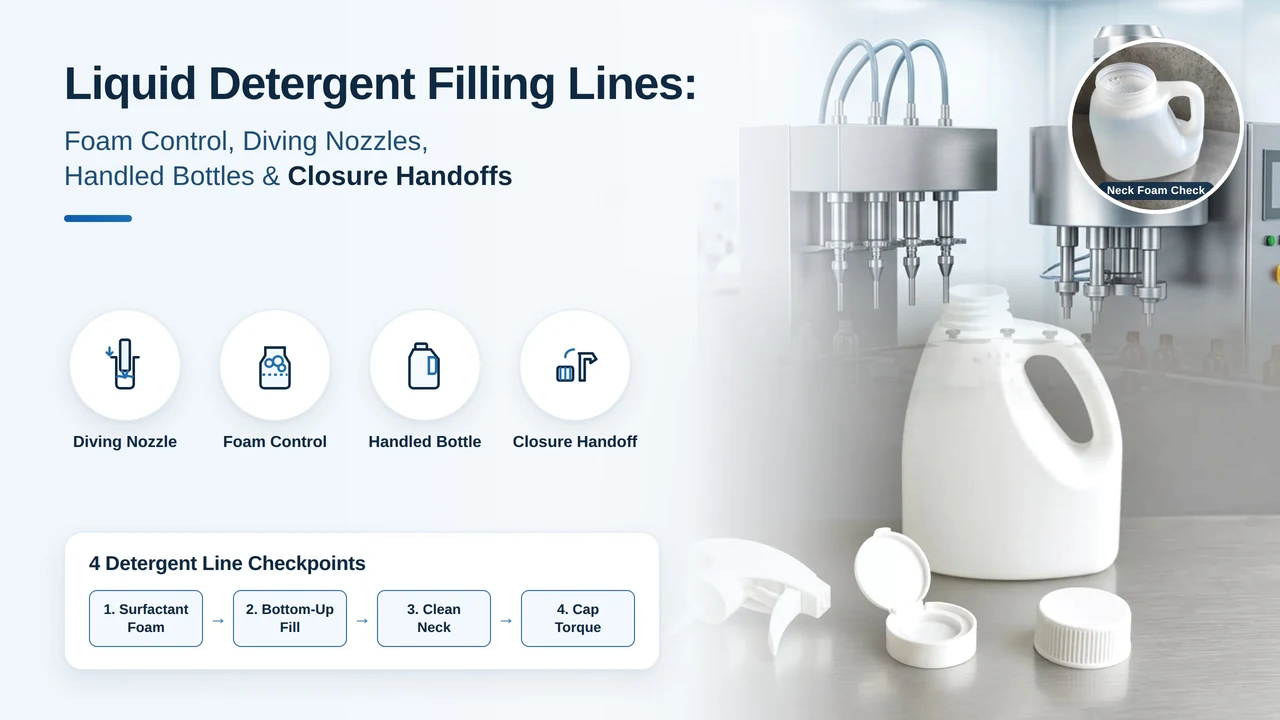
Quick View: What to Write for Each Detergent SKU
Scroll across to read all three columns.
| Input | What to write | Why it matters |
|---|---|---|
| Product | Product name, the product sheet or safety data sheet, and the filling temperature | The supplier checks the parts the product touches against your formula, not against the word detergent. |
| Flow | Thin and free-flowing, or thick like a gel, in your own words | Flow at the working temperature affects supply, valve passage and dose timing. |
| Foam observation | Where foam sits after a pour into your bottle, and whether it settles before the bottle could be capped | Compare nozzle entry, flow transitions and cutoff with the foam location and settling behavior. |
| Bottle | Photos showing the neck, the handle and the shoulder, and the fill quantity | Neck size, height and shape move the nozzle position, the capping head, the guide rails and the labeling parts. |
| Closure | Screw cap, flip-top, or trigger sprayer with dip tube | Flip-tops and pumps need orienting first, and we handle trigger sprayers case by case. |
| Material confirmation | Product-contact component list and material grades for the formulation | Evaluate the product and cleaning agents at their working temperatures against the selected materials. |
Match the Formula, Fill Motion and Bottle
For liquid detergent in bottles, coordinate the fill motion, product-contact materials and bottle support. Foam in the neck, an offset opening or an unstable handled bottle can change the nozzle and closing arrangement.
Observe the formulation at filling temperature and compare the fill motion with its foam and flow behavior. Specify the valves, seals and nozzle path alongside the bottle restraint and the transfer to capping. Corrosive or flammable formulations require a separate materials and machinery-safety assessment.
What Does the Foam Do in Your Bottle?
Start with an observation, not a number. Pour the product into the bottle you plan to sell it in, at the temperature it will be filled, and note where the foam sits: in the neck, on the shoulder, or only on the surface. Then note whether it settles before the bottle would reach a capper.
Foam in the neck can interfere with dose verification and leave product near the closure. Like shampoo, detergent needs a filling path matched to its actual foaming behavior. Record flow and foam for each formulation at the intended filling temperature.
Write how your product pours in plain words, and say so if two SKUs behave differently, because they may need different settings or a different method.
Takeaway: Describe the foam in the bottle you will sell, at the temperature you will fill, before you compare fill motions.
Nozzle Motion and Bottle Guides
Compare the nozzle path and flow profile with the bottle cross-section and observed foam. Supply conditions and entrained air also affect the filling result.
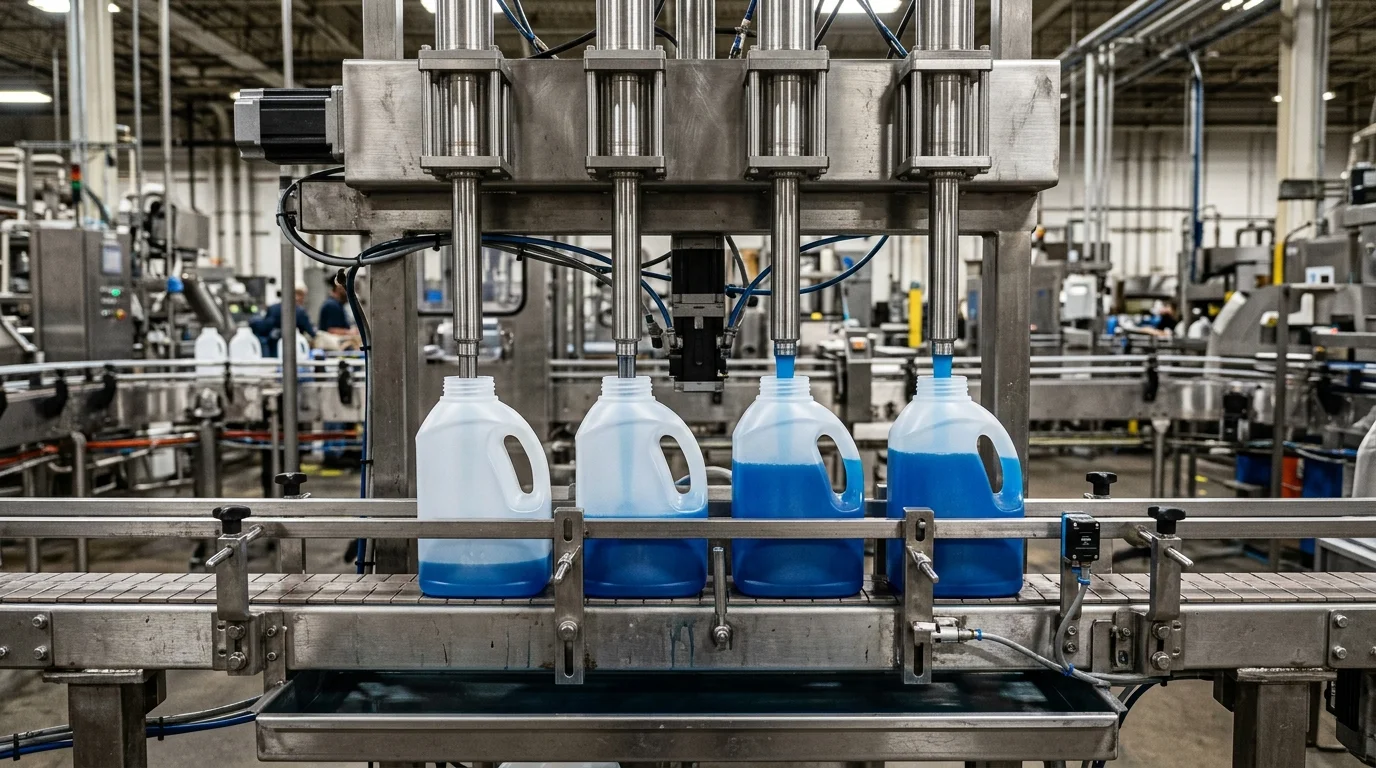
Compare Fill Motions with the Actual Detergent
These motions address different parts of the filling task. Define their role for each formulation and bottle before comparing output.
| Fill motion | How it works | Configuration and trial check |
|---|---|---|
| Bottom-up or diving nozzle | The nozzle enters the container and follows an agreed filling and withdrawal path. | Review neck access, liquid rise, nozzle travel and cutoff together. |
| Slow-fast-slow profile | The commanded flow changes during the dose. | Define transition points from the bottle shape and observed foam; retain the profile with the SKU. |
| Overflow filling | A nozzle returns excess product to maintain a defined fill level. | Review returned foam and product supply; visible level is a different basis from metered volume or net mass. |
| Electromagnetic flowmeter | The meter measures flow of a conductive liquid through its sensing path. | Confirm conductivity and suitability for the actual detergent and conditions. |
| Piston or pump metering | A displacement device controls the delivered portion. | Review the valve, seals, refill and nozzle with the formulation. |
Takeaway: A fill motion sold against foam still needs your bottle, your neck and your SKU written beside it.
The Detergent Line Record
Copy one row per SKU and bottle. You fill the first three columns. The supplier answers the last two. Leave a cell empty when you do not know it, and send it back empty.
| Product | Bottle | Foam observation | Fill motion | Capping and labeling hand-off |
|---|---|---|---|---|
| You write: product name, flow in your words, filling temperature | You write: photos of the neck, handle and shoulder, and the fill quantity | You write: where foam sits after a pour, and whether it settles before capping | Supplier answers: bottom-up, slow-fast-slow, overflow, flowmeter, piston or pump | Supplier answers: how the bottle is held into the capper, the closure, the label type, and where a foamy or wet neck is caught |
Takeaway: Empty cells stay empty until the supplier answers them.
Support for Handled Bottles
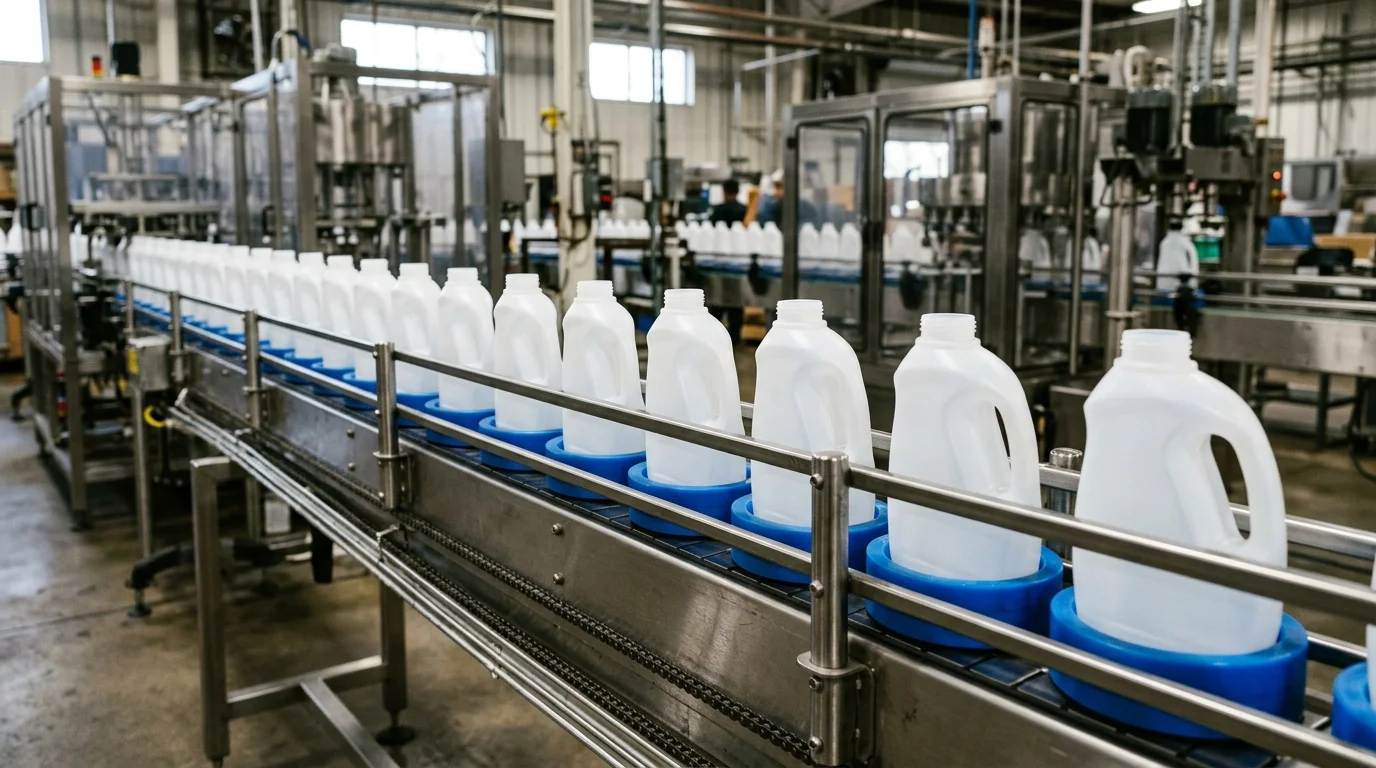
Support and orientation must keep the actual handled bottle positioned through transfer and closing. Assess guides, locators, gripping and any carrier tooling with the required pack range.
Material Confirmation Fields
Identify each wetted component, its material grade and the seal compound. Compare the complete formulation and cleaning agents at their working temperature and concentration with the component supplier’s compatibility information. Include hoses, valve seats and nozzle seals alongside metal parts.
| Field | Who answers | Answer |
|---|---|---|
| Product sheet or safety data sheet sent | You | |
| Filling temperature | You | |
| Parts the product touches, named one by one | Supplier | |
| Seal and hose material for this formula | Supplier | |
| Cleaning between SKUs, and which parts come apart | Supplier | |
| Conductivity confirmed, if a flowmeter is quoted | Supplier |
Keep the selected materials and their operating conditions with the formula and cleaning record.
How Does the Bottle Reach the Capper?
Keep the container located under the nozzle and supported during departure. Guides, indexing gates, neck location or carrier tooling may be needed according to the actual bottle geometry. Include the no-container and downstream-blocked responses in the station control definition.
For a handled bottle with an offset neck, check the base, handle, shoulder and opening from the side and above. Their positions determine the guide and nozzle access. The liquid filling lines page connects these checks to closing and labeling.
Record the parts and adjustments for every bottle format. Check the transfer into bottle restraint at the capper using the filled container.
Closing-Head Approach
Define closure presentation, tube insertion where applicable, bottle restraint and tightening checks together. Include wet-neck and misplaced-closure observations in the configuration acceptance run.
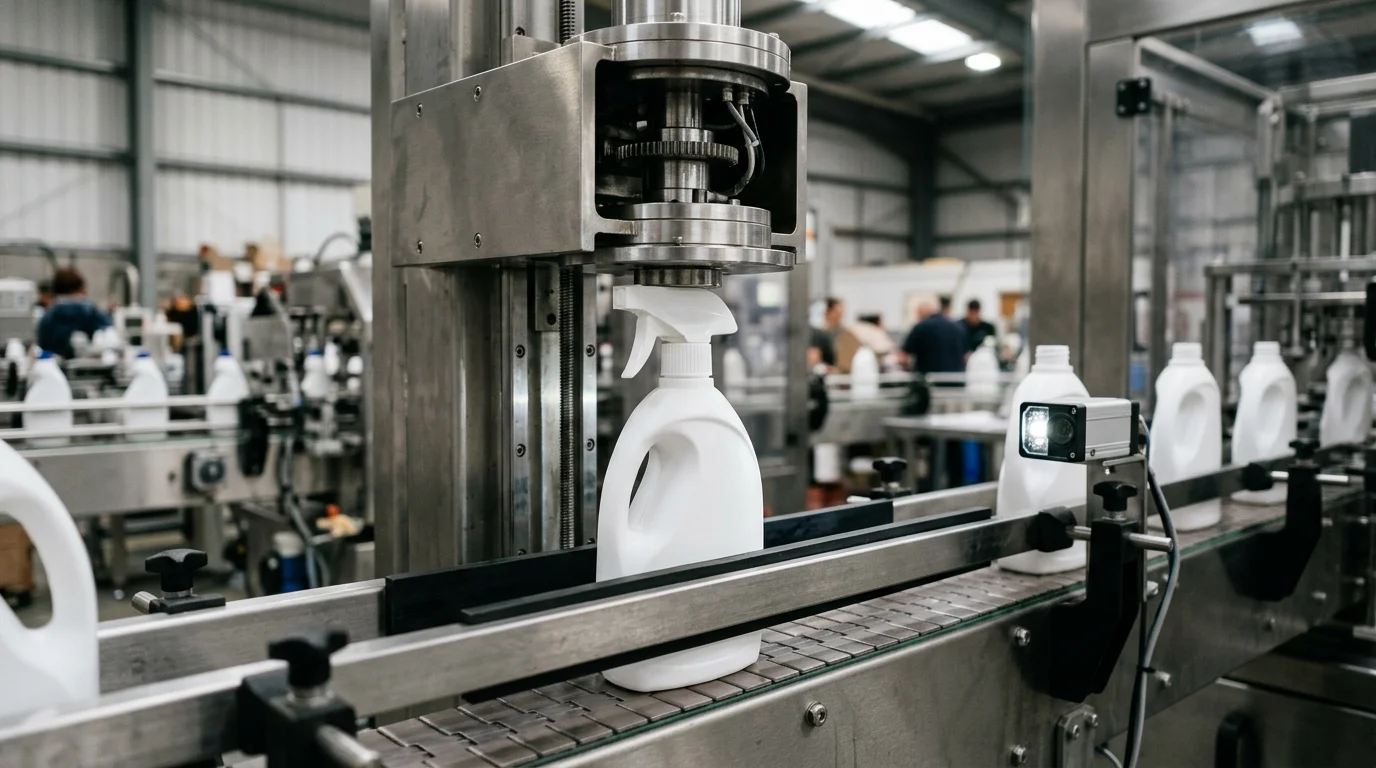
Capping and Labeling Hand-off
Capping comes after filling, and the cap is what keeps the product from leaking. The closure decides the capping step. Flip-top and pump closures need orienting first, and trigger sprayers and pumps with dip tubes are slower to handle, so we look at them case by case.
For a trigger sprayer, separate tube entry, closure orientation, placement and tightening. Match the complete assembly to its bottle neck, and support the bottle against the closing force. Define the tool and adjustment for each closure in the format list.
Labeling follows the bottle shape: wrap-around labels for round containers, flat-surface labels for square, flat or oval bottles, and shrink sleeves for full-body coverage. Write the label type for each SKU next to its bottle.
Foam and drips reach the capper first. Ask the supplier where a bottle with foam or product on the neck would be caught. Some filling machines carry checks such as weight checkers or vision systems. If you need one, the quotation should name it.
Takeaway: Write the closure and the label type for every SKU, and ask where a foamy neck is caught.
Connect the Review to the Complete Line
Carry the detergent formulation, bottle format and selected filling path into the station scope. Assign product preparation and bulk supply separately from packaging, and define where the bottle condition is checked before closing and labeling.
For a quoted speed, put the quote and your own count on one basis with filling line speed and good output. For the rest of the line, start from how to choose a filling line.
What to Send Us
These are the items the record above already uses. Unknown is an acceptable answer for any of them.
| Item | Why we need it | Example format |
|---|---|---|
| Product sheet or safety data sheet | Lets the supplier name the wetted parts and seals for your formula | PDF, or the product name if you have no sheet yet |
| Filling temperature | Foam and flow are observed at this temperature | Room temperature, or a value in °C |
| Flow and foam description | Sets which fill motions are worth comparing | Pours like water; foam sits in the neck and settles slowly |
| Bottle photos and fill quantity | Shows the neck, the handle and the shoulder | Side and top views of each bottle, with its fill quantity |
| Closure type or photo | Decides the capping step | Screw cap, flip-top, or trigger sprayer with dip tube |
Calculate Level Rise and Product Loss from Measurements
In a uniform bottle section with a stationary immersed nozzle, liquid rise speed in mm/s = flow in mm³/s / (bottle internal area − immersed nozzle area), with areas in mm². Convert measured flow using 1 mL = 1000 mm³. Use the bottle’s actual internal cross-section at the liquid level; a shoulder or neck changes that area and therefore the rise speed.
For concentric circular sections, free annular area in mm² = π × (neck bore² − nozzle outside diameter²) / 4. Compare the drawing tolerances, nozzle motion and available vent path during the fill. Establish the operating flow and withdrawal path with the actual formulation and bottle.
For one accounting period, giveaway cost = measured excess product in L × product cost/L. Add unrecoverable reject quantities × their unit costs, with recoverable product and packaging recorded separately. Use actual production counts, measured fill quantities and invoices from that same period before comparing alternatives.
[Sources]
- Detergent filling discussion: formulation flow, foam and alternative filling methods. qualipakmachines.com/how-to-choose-a-foaming-detergent-filling-machine/
- Piston filling: adjustable nozzle lift, above-mouth or bottom-up motion and variable fill-speed profile. www.jpacks.com/Product/JPF-Series-Automatic-Bottle-Liquid-Piston-Filling-Machine.html
- Electromagnetic flowmeter filling: conductive products, nozzle motion and bottle handling. www.jpacks.com/Product/JFM-Series-Automatic-Electromagnetic-Flowmeter-Liquid-Filling-Machine.html
- Chuck and spindle capping: closure engagement, bottle handling and mechanism selection. www.epakmachinery.com/blog/chuck-cappers-vs-spindle-cappers/
- LINEVO packaging-line planning: station scope, common count basis, transfer interfaces and system acceptance. linevopack.com/solutions
Common Engineering Questions: Liquid Detergent Filling Lines, Foam Control & Handled Bottles
- 01Which filling method suits liquid detergent?
- Review the actual formulation, foam, conductivity, dose and container. A piston, pump, flowmeter, net-weight or overflow route answers a different metering or presentation task; define that task before the configuration acceptance run.
- 02Does a diving nozzle remove all foam?
- A controlled filling path can change splash and air entrainment during the dose. It does not remove air already present upstream. Assess supply, flow profile, bottle venting and cutoff together with the actual detergent.
- 03How are handled bottles supported?
- Review the offset neck, handle, base stability and closure reaction. The configuration may use guides, neck location, gripping or carrier tooling; select it from the actual container and transfer trial.
- 04Should the line use a spindle or chuck capper?
- Use the closure assembly and bottle drawing to define feeding, orientation, tube insertion, gripping and tightening. Include surface appearance and closing checks in the trial.
- 05Why can accurate volume still give a different net mass?
- Mass equals volume multiplied by density under the stated conditions. Temperature, entrained air and formulation changes can alter that relationship. Define the target quantity and verification method for the product and market.
[Request]
Send the Product, Bottle and Closure
Discuss the recorded detergent, fill path and closure requirements in the detergent-line review.
Our team reviews your product, container and line requirements with you.
[Keep planning]
- Liquid Filling LinesFoam, drip or a narrow bottle opening can make the wrong filler a poor fit. Start with liquid behavior and container dimensions, then match the filling and downstream stations.
- Paste Filling LinesAir and stringing in a paste end up as short fills and dirty seals. Tell us how your product behaves at filling temperature and we configure the feed, dosing and sealing around it.
- ShampooFoam in the neck can cause short fills and a messy bottle. Define the shampoo’s filling condition, bottle opening and closure before selecting filling and capping stations.
- Line LayoutPlan filling line space around product movement, machine interfaces, operation and service access. The final layout should connect the selected equipment with actual site dimensions, utilities and the move-in route.
- Filling Line CostCompare filling line prices after matching the stations, formats, integration and delivery scope. Then add installation, site work and operating costs on the same accounting basis.
- How to Choose a Filling LineChoose a filling line from the product and container, then define accepted output, the automation boundary, utilities and the stations supplied. The configuration review connects these requirements before equipment is built.
- RFQ ChecklistPrepare a filling line RFQ with the product, container and closure, required accepted output, site layout and delivery scope. A shared brief lets engineering define each station and its interfaces on the same basis.
- Semi-Automatic Bottle LineBuild a semi-automatic bottle filling line by deciding which tasks remain manual and which stations need automatic handling. Review filling, capping, labeling and transfers separately, then plan the interfaces needed for the next upgrade.
- Volumetric vs Net WeightChoose volumetric or net weight filling from the quantity each container must hold. Volume, net product mass and visible fill level are different measurements; define the target unit, tare and product conditions before comparing metering methods.
- Piston vs Gear PumpA piston filler meters through a cylinder stroke; a gear pump filler meters through rotating gears. Compare their product path, valve, seals, dose adjustment and refill behavior with the actual formulation, then connect the selected meter to bottle handling and cleaning.
- Line Speed and Good OutputCompare filling line speed using accepted bottles at the same count point and over the same time window. Separate individual machine cycles from complete-line output, and record stops, rejects and format conditions with the count.
- Cosmetic Bottle Format PlanningPlan cosmetic bottle formats with one record per finished SKU. Product, container, closure, label and the change between SKUs determine which settings, contact parts and handling tools the line needs.
- Paste Filler Parts IdentificationIdentify paste filling machine parts by the machine record, the component function and the product path. Separate wear seals from valve hardware and format parts, then check the drawing and material before ordering a replacement.